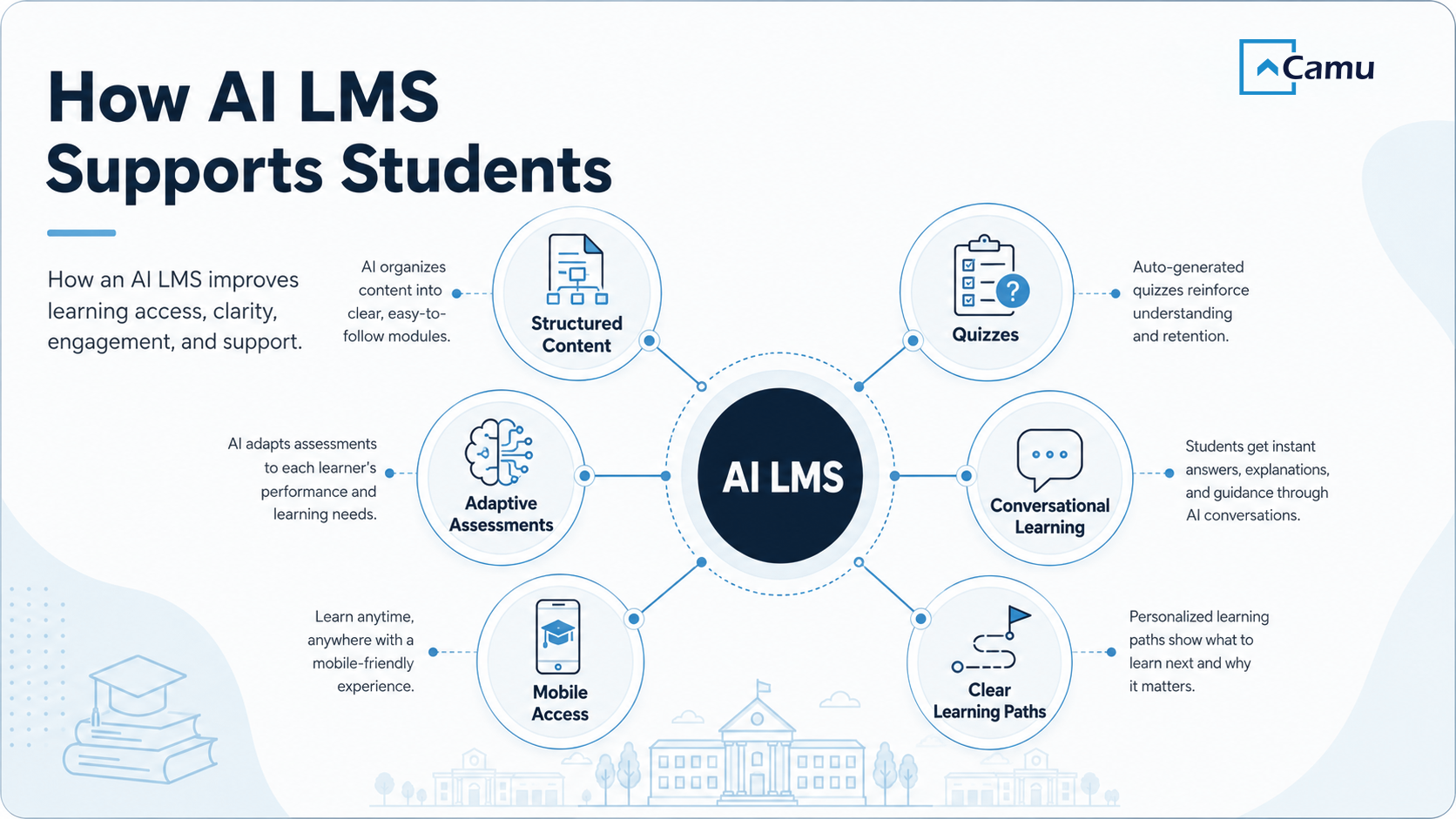
An AI LMS improves student learning by connecting curriculum design, course content, assessments, and faculty review inside one academic workflow.
Using external AI tools for content creation can create disconnected workflows, manual effort, and governance gaps.
Camu AI Content Studio helps faculty create LMS-ready courses, quizzes, assessments, and learning resources from existing academic material.
Faculty review remains essential to keep AI-generated course content accurate, relevant, and aligned with academic standards.
Why Student Learning Experience Starts with Curriculum Design
Student learning experience begins long before a learner logs into the LMS. It starts with curriculum design.
Curriculum defines what students learn, how learning is delivered, how assessments are structured, and how outcomes are measured. When the curriculum is clear, students receive a stronger learning path. When it is fragmented, the learning experience becomes inconsistent.
This is where an AI LMS becomes important.
An AI LMS helps institutions bring AI into the academic workflow, not as an external tool, but as part of the same system where teaching, learning, assessment, and student engagement happen.
Many institutions use external AI tools for content creation. This creates a common problem. Content is generated outside the LMS, copied manually, edited separately, and then uploaded again. This creates disconnected workflows. It also creates governance concerns.
Institutions may lose visibility into:
Who created the content
Which AI model was used
Whether the content was reviewed
Whether faculty approved it
How the content was published
Whether it aligns with academic standards
An AI LMS solves this problem by keeping the workflow inside the learning system.
Faculty create, review, approve, and publish content in one place. This improves academic control, review visibility, content consistency, LMS publishing speed, and governance
How Camu AI Content Studio Supports AI LMS Workflows
Camu’sAI Content Studio helps institutions bring AI content creation into LMS workflows.
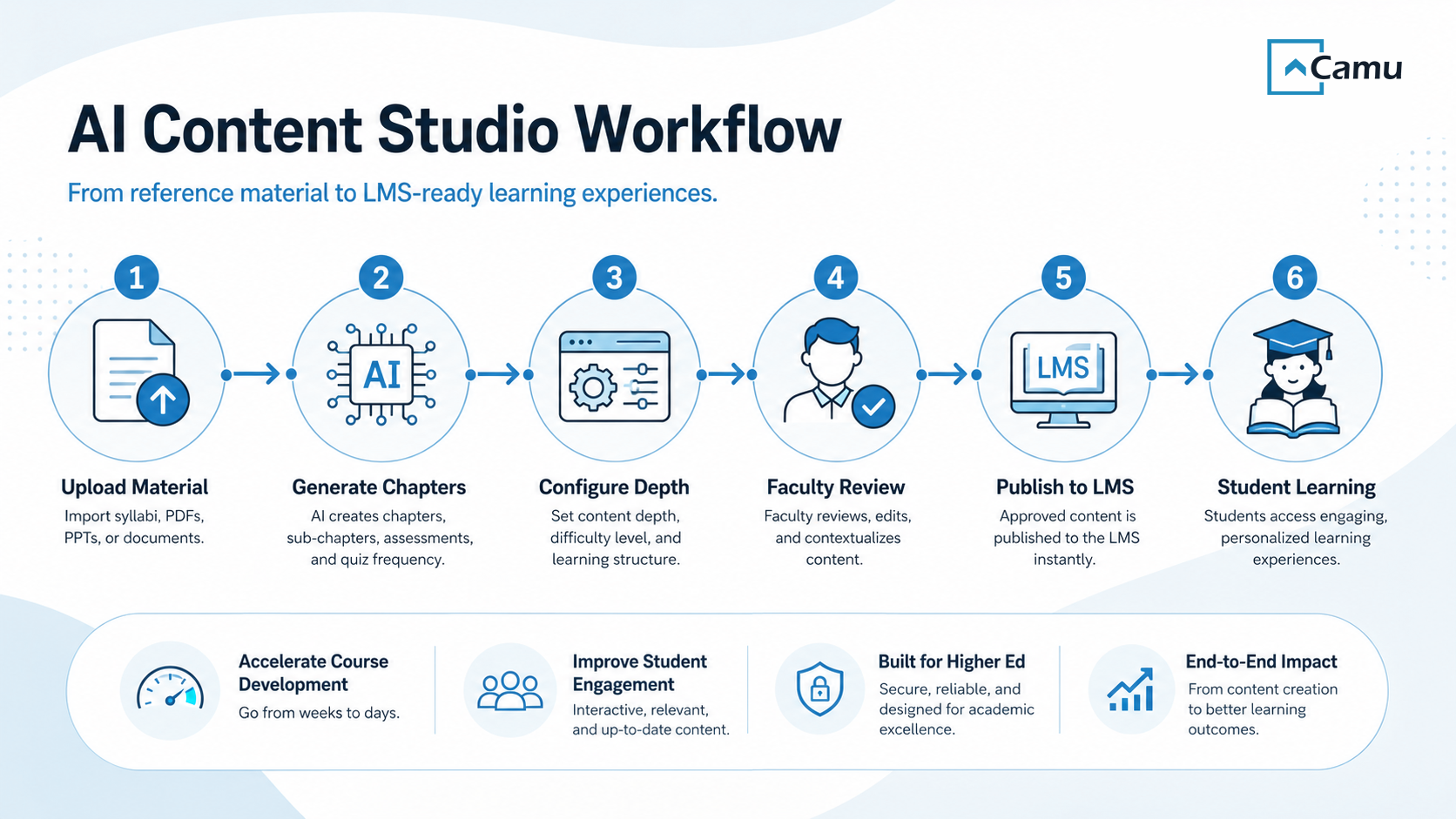
It supports the full content lifecycle, from reference material to LMS-ready courses.
The workflow includes:
Upload existing contentFaculty can upload syllabi, PDFs, PPTs, documents, and learning material.
AI-driven course structuringThe system helps generate chapters, sub-chapters, assessments, and quiz content.
Configure depth and difficultyFaculty can define content depth, assessment complexity, and learning structure.
Faculty review and editGenerated content remains editable and reviewable.
Publish to LMSApproved content can be published into the LMS and made available to learners.
This gives institutions a practical way to use AI in learning management systems without losing academic oversight.
Why Faculty Review Still Matters
AI-generated course content should not go directly to students without academic review. Faculty oversight is essential. AI can help create, structure, and organize content faster. But faculty bring academic judgment, subject expertise, institutional context, and learner understanding.
That is why faculty review must remain part of the workflow.
With Camu AI Content Studio, faculty can:
Review generated content
Edit chapters and sub-chapters
Refine explanations
Personalize learning material
Contextualize examples
Validate assessments
Approve content before publishing
This keeps faculty in control. The goal is not to replace faculty effort. The goal is to reduce repetitive preparation work and give faculty more time to focus on quality, teaching, and student engagement.
How Assessments Improve the Learning Experience
Assessments shape how students learn.
If assessments are unclear or disconnected from the course content, students struggle to understand what is expected. If assessments are aligned with the learning path, students get better feedback and clearer academic direction.
An AI LMS supports assessment design by helping faculty create quizzes, assignments, and assessments from course material.
It can support:
Quiz generation
Assessment creation
Difficulty-level configuration
Assessment complexity settings
Personalized assessments
Adaptive assessment patterns
Mastery-based evaluation
This improves the student experience in two ways.
First, students receive assessments that are connected to what they are learning.
Second, faculty get more support in creating regular checks for understanding.
Assessment becomes part of the learning journey, not only an end-stage evaluation.
From Better Content to Better Learning Outcomes
Student learning experience improves when curriculum, content, assessments, and faculty review are connected.
An AI LMS helps institutions create this connection.
It supports faculty by reducing repetitive content preparation work. It supports students by giving them structured, accessible, and assessment-ready learning material. It supports institutions by keeping AI use inside governed academic workflows.
The result is not only faster course preparation.
The result is better learning structure, stronger engagement, and improved academic visibility.
CTA
Explore how Camu’sAI Content Studio helps institutions create LMS-ready courses, assessments, quizzes, and learning resources inside an AI LMS with faculty review before publishing.
FAQs
1. What is an AI LMS?
An AI LMS is a learning management system with AI capabilities built into course content creation, assessment generation, learner engagement, and faculty workflows.
2. How does an AI LMS improve student learning experience?
An AI LMS improves student learning by helping faculty create structured content, quizzes, assessments, and LMS-ready learning resources that students can access in one connected system.
3. Why should AI content creation happen inside the LMS?
AI content creation should happen inside the LMS because it keeps content creation, faculty review, approval, publishing, and student access within the same academic workflow.
4. Why is faculty review important for AI-generated course content?
Faculty review ensures AI-generated course content is accurate, relevant, contextual, and aligned with academic standards before it reaches students.
5. How does Camu AI Content Studio support an AI-powered LMS?
Camu AI Content Studio helps institutions convert syllabi, PDFs, PPTs, and notes into LMS-ready chapters, quizzes, assessments, and learning resources with faculty review and approval before publishing.