Is your Student Information System still keeping up with your University?
A student information system supports core university operations, from admissions and enrolment to academics, attendance, assessments, fees, student services, and graduation.
For universities evaluating student information system software for universities, the question is no longer whether the existing system still works. The question is whether it supports how your university operates today.
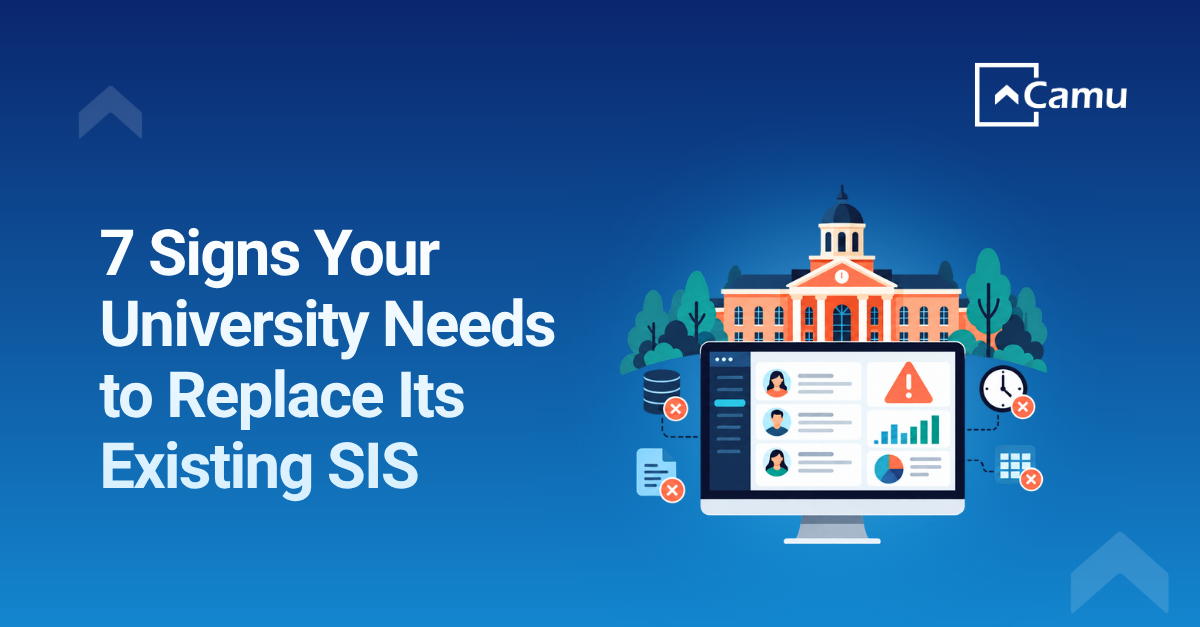
Here are seven signs your existing SIS may need to be reassessed.
1. Your Teams Keep Entering the Same Student Data
One of the clearest signs of an ageing SIS is repeated data entry.
If admissions, academics, finance, examinations, and student services maintain separate versions of the same information, every handoff creates additional work and opportunities for inconsistency.
A modern student information system should provide a structured student record and allow authorised users to work with relevant information across connected workflows.
Centralised records and defined workflows are core functions of modern SIS platforms.
2. Your SIS and LMS Work as Separate Systems
If students and faculty need different systems for student records and learning activities, your university is dealing with a fragmented digital environment.
A connected SIS and LMS reduces this separation by allowing relevant student and academic information to flow between administrative and learning workflows.
For example: Student enrolment → Course registration → LMS access → Learning activity → Academic record
If these processes operate independently, your university may be carrying unnecessary integration and administration overhead.
3. University Reporting Still Depends on Spreadsheets
Ask yourself how long it takes your team to prepare an institutional report.
CHED's HEMIS data collection includes institutional profiles, programmes offered, enrolment, graduate data, faculty information, and graduate lists.
CHED's reporting guidance also includes validation, consolidation, and submission of institutional data.
CHED's newer HEIDA platform places further emphasis on structured institutional records, review workflows, historical context, controlled access, and analytics.
4. Every Academic Change Requires a Workaround
Universities rarely operate with static academic structures.
Programmes are revised, Curricula change. Courses are added or removed. Registration rules vary across programmes.
Universities also introduce new delivery models and academic structures.
If routine changes require extensive manual work or repeated vendor intervention, the SIS may not provide enough configurability.
5. Students Still Depend on the Administration Office for Routine Tasks
Another sign is the amount of work students still need to complete through manual requests.
If students regularly need to visit an office or send emails to check academic information, submit service requests, view fees, access documents, check grades, or receive important updates, then your current SIS might not be providing enough self-service access.
This also reduces routine administrative interactions and gives students more control over their own academic journey.
Camu's Philippine implementation with Miriam College, for example, includes streamlined registration and enrolment, mobile access to student information, online payments, and real-time transaction updates.
6. Your University Has Outgrown Its Current Architecture
A system that worked for one campus or a smaller student population might struggle as the institution expands.
Growth introduces new requirements, and if adding a new campus, programme, or workflow requires significant changes to the existing system, it is worth reassessing whether the platform is designed for your university's future requirements.
Multi-campus capability is particularly important for universities operating across different locations.
Scalability and interoperability are established considerations when evaluating SIS platforms for higher education.
7. Your SIS No Longer Meets Your Security and Data Governance Requirements
What happens when your university’s SIS keeps growing, but its security and data governance controls do not?
Academic records such as grades, examinations, performance evaluations, rubrics, and teacher comments are considered sensitive personal information under the Philippine Data Privacy Act.
Your SIS should provide appropriate role-based access, user permissions, data protection controls, and secure integrations.
Universities should also review auditability, data storage and backup, and clear data governance responsibilities when evaluating an SIS.
What Should You Look for in a Replacement SIS?
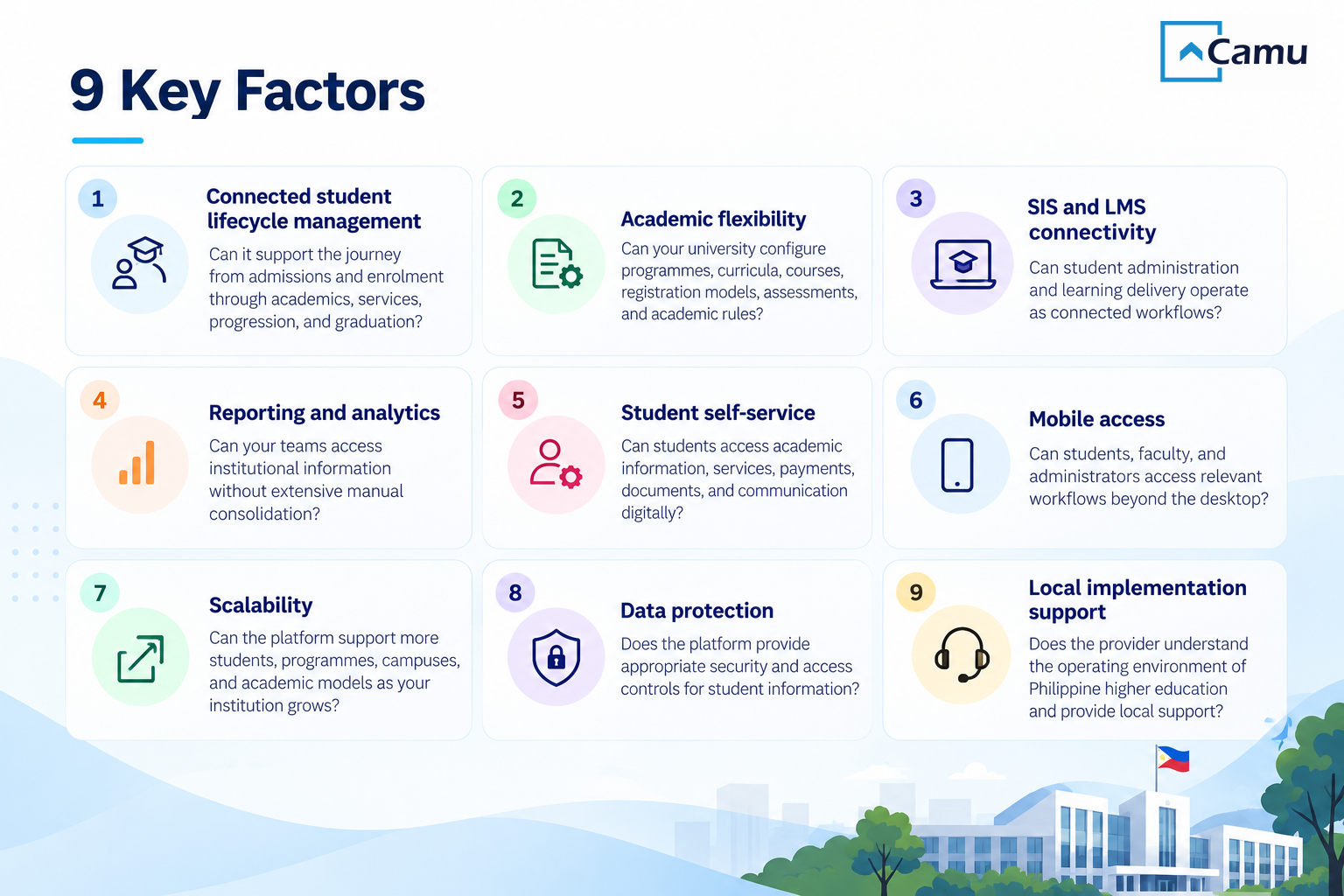
Replacing an SIS should solve the limitations of the existing system rather than reproduce them. Evaluate the replacement against these areas:
How Camu Supports Universities in the Philippines
Camu provides a unified Student Information System and Learning Management System for higher education institutions in the Philippines.
Supports the student lifecycle from admissions to graduation, including student records, curriculum planning, assessments, grading, attendance, academic advising, reporting, and compliance-related workflows. It also provides real-time dashboards and compliance-ready reports.
Camu also supports Philippine institutions, with implementations including Mapúa Malayan Digital College and Miriam College, helping institutions manage connected academic and administrative workflows.
When Is It Time to Replace Your SIS?
A university does not need to replace an SIS simply because it is old. The stronger signal is operational limitation. The right replacement should give your university a connected foundation for student information, academic operations, learning delivery, reporting, and student services.
1. When should a university replace its existing SIS?
A university should consider replacing its SIS when persistent limitations affect core operations, such as repeated data entry, disconnected systems, limited reporting, weak student self-service, poor scalability, or difficulty supporting new academic requirements.
2. What should universities consider when replacing an SIS?
Evaluate academic flexibility, integrations, reporting, student self-service, mobile access, scalability, security, implementation support, and the ability to support the complete student lifecycle.
3. Why is SIS and LMS integration important?
SIS and LMS integration connects student administration with learning delivery. It helps align enrolment and academic records with learning workflows and reduces fragmented processes.
4. Is data security important when choosing a student information system in the Philippines?
Yes. The National Privacy Commission identifies academic records such as grades, examinations, performance evaluations, rubrics, and teacher comments as sensitive personal information under the Data Privacy Act. Universities should therefore assess access controls, data protection, security, and governance when selecting an SIS.
5. Does Camu support universities in the Philippines?
Yes. Camu has a dedicated Philippines offering, local implementation support through ITSM Corp., and documented implementations including Mapúa Malayan Digital College and Miriam College.
7 Signs Your University Needs to Replace Its Existing Student Information System