An AI-powered LMS goes beyond adding a chatbot. It embeds AI into course creation, teaching, assessment, and learning workflows.
Faculty can use AI to create structured course content faster while retaining academic control to review, edit, and contextualize the output.
Students get a more interactive and responsive learning experience, with greater opportunities for practice, contextual support, and personalised learning.
Universities should evaluate AI LMS platforms based on integration, academic control, privacy, governance, AI model flexibility, and measurable value.
For years, universities have used Learning Management Systems to organize courses, deliver learning materials, manage assignments, conduct assessments, and track student progress.
An AI-powered LMS is not simply a traditional LMS with a chatbot added. The bigger change happens across course creation, faculty workflows, assessment, and the student learning experience.
This changes the experience for both faculty and students.
What Is Changing in the Learning Management System?
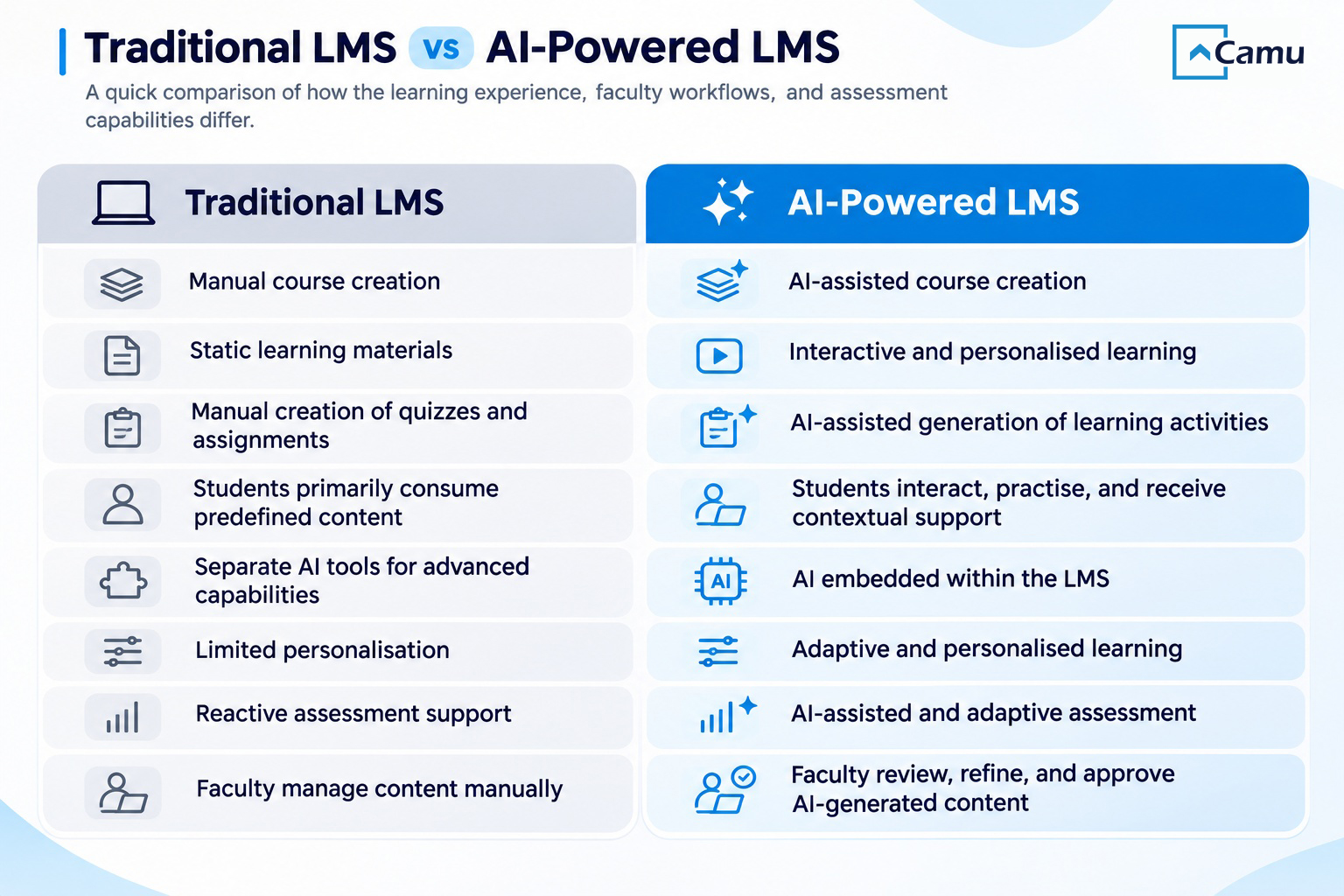
A traditional LMS primarily helps institutions organize and deliver learning. Faculty create course content, upload resources, configure assignments and quizzes, and manage student activities. An AI-powered LMS adds intelligence to these workflows.
AI can help structure course content, generate learning activities, support contextual student questions, and adapt assessments based on learner performance.
The LMS becomes a more active part of the teaching and learning process.
Traditional LMS vs AI LMS
How Camu Brings AI Into the Learning Management System
Camu takes an embedded approach to AI.
Camu’s AI Content Studio is built into the LMS, allowing faculty to generate course content within the course-authoring environment.
Camu also positions its AI architecture around model flexibility and institutional control, with integration options for Google Gemini and ChatGPT and an open API approach focused on privacy and cost control. For a broader view of how these capabilities fit into the learning environment, explore Camu's AI Content Studio.
What Changes for Faculty?
The biggest change for faculty is the shift from managing LMS administration to using the LMS as a teaching and academic support environment.
1. Course Creation Becomes Faster
In a traditional LMS, faculty typically prepare course materials, organise chapters, create assessments, and upload resources manually.
With Camu AI Content Studio, faculty can provide source material such as syllabi, PDFs, PPTs, or text prompts and generate structured digital courses with chapters, sub-chapters, learning content, assessments, and learning outcomes.
Faculty still retain editorial control. AI-generated content can be reviewed, edited, refined, and approved before it is published.
2. Teaching Content Becomes More Interactive
Traditional LMS content often relies on documents, presentations, videos, and other uploaded resources.
An AI-powered LMS can transform existing teaching material into different learning formats.
Camu supports avatar-based and audio-visual teaching modules generated from faculty notes and slides, including multilingual learning experiences.
What Changes for Students?
The student experience also changes significantly.
A traditional LMS largely waits for students to access content, complete activities, and submit assessments. An AI-powered LMS can respond to individual learning needs as students progress.
1. Learning Becomes More Bite-Sized
Students do not always need to revisit an entire chapter to revise one concept.
The AI Content Studio provides AI-generated snippets, quizzes, and flashcards within the learning environment.
Students can use short summaries to revise, take quick self-assessments, and review concepts with interactive flashcards.
2. Students Get Context-Aware Assistance
Traditional LMS support often depends on faculty communication, discussion forums, or external help.
With Camu's avatar-based and audio-visual teaching modules, students can ask questions through text or voice and receive responses grounded in their course material.
This means students do not have to leave the learning environment every time they need clarification.
What Should Universities Look for in an AI LMS?
Universities should look beyond whether an LMS has an AI assistant.
Ask:
Is AI embedded into the LMS or dependent on separate tools?
Can faculty generate structured course content from existing academic resources?
Does AI support the student learning experience, not only faculty content creation?
Can assessments respond to learner performance?
Does the platform support practical learning for technical subjects?
How are institutional data, privacy, AI models, and costs governed?
Can approved AI-generated content move directly into the LMS?
The right AI LMS should strengthen the existing academic environment, not create another disconnected technology layer.
Conclusion: The Shift From Traditional LMS to AI-Powered Learning
AI is changing the LMS from a system for managing learning into a more active part of the teaching and learning process. Faculty get support with content creation, while students gain more interactive and personalised learning experiences.
Feedback from Rathinam Group of Institutions’ faculty evaluation of Camu AI Studio also highlighted its ease of use, productivity benefits, document-based content generation, and subject-aligned outputs.
If your institution is evaluating this transition, book a demo with Camu to see how an AI-enabled LMS fits into your academic workflows.
Frequently Asked Questions
What is Camu’s AI Content Studio?
Camu’s AI Content Studio is an AI-powered course creation engine built into the LMS. It helps faculty transform existing academic resources into structured digital courses with chapters, sub-chapters, assessments, and learning outcomes.
How does Camu AI Content Studio create course content?
Faculty can provide source materials such as syllabi, PDFs, PPTs, documents, or prompts. The AI then structures the material into course content based on the required learning structure, content depth, assessments, and quiz configuration.
Can faculty edit AI-generated content in Camu?
Yes. Faculty retain control over the generated content. They can review, edit, refine, and contextualize the material before approving and publishing it to the LMS.
Does Camu AI Content Studio work with existing LMS courses?
Yes. AI-generated content can be brought into the LMS, while existing course content can also be reused across academic cycles. This allows institutions to combine AI-assisted course creation with their existing learning content.
Which AI models does Camu support?
Camu’s AI Content Studio is integrated with Google Gemini and ChatGPT, with options to choose the LLM models used for course content creation. Its open API architecture also supports institutional control over AI model integration, privacy, and cost.