ODL programs need more than online content delivery.
A standard LMS supports learning, but not the full learner lifecycle.
Flexible ODL models need strong academic pathway management.
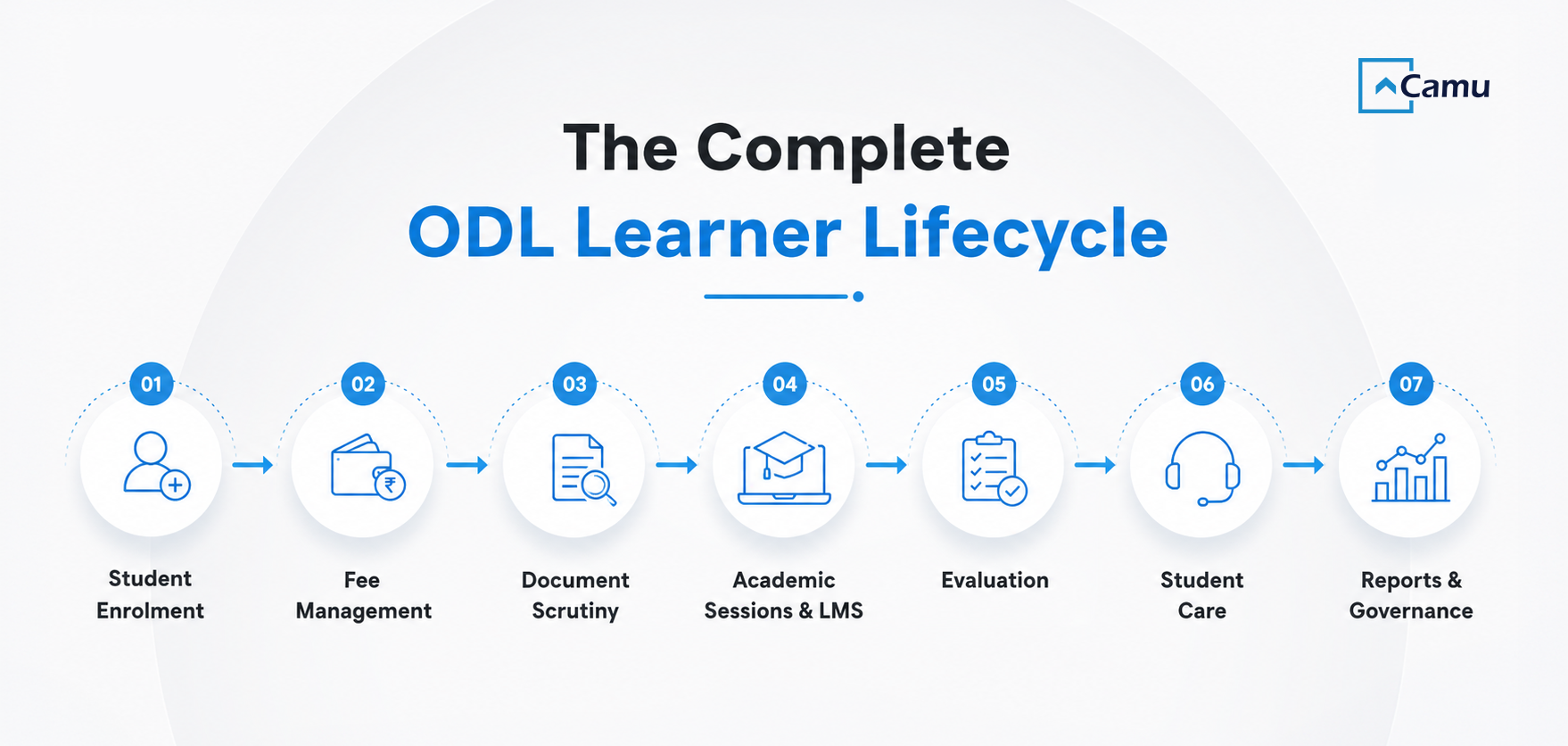
Institutions need connected workflows for enrolment, fees, documents, evaluation, student care, and reporting.
Camu supports ODL through a connected digital ecosystem built for higher education.
What Does Better ODL Management Mean Today?
Open and Distance Learning is no longer limited to uploading course content and conducting online classes. For universities, ODL has become a complete academic delivery model that requires structure, visibility, governance, and learner support at scale.
Many institutions begin with a standard LMS because it solves the most immediate need: digital learning delivery. Faculty upload materials. Students access courses. Assignments and quizzes move online.
But as ODL programs grow, this approach starts showing gaps.
A standard LMS may deliver content, but an ODL learning management system must support the complete learner journey. This includes student enrolment, fee workflows, document scrutiny, academic sessions, evaluation, student care, flexible progression, integrations, and reporting.
For institutions looking to manage these workflows through one connected environment, Camu’sODL platform supports online and distance learning across learning delivery, administration, evaluation, student services, and academic operations.
Why Standard LMS-Based ODL Falls Short
A standard LMS is useful for learning delivery. This works well when the goal is only to move classroom content online.
But ODL is wider than classroom delivery.
Students are remote. Administrative teams are distributed. Academic records need accuracy. Evaluations need structure. Learner support needs tracking. Compliance and reporting need reliable data.
When institutions depend only on a standard LMS, several gaps appear.
Admissions and onboarding sit outside the learning system.
Student records remain disconnected.
Fee payments need manual reconciliation.
Exam slot booking and evaluation need separate processes.
Student queries move through calls, emails, or informal channels.
Reports take time because data sits in different systems.
Leadership has limited visibility into learner progress and operational health.
This is why ODL needs a connected digital ecosystem, not only an LMS.
What ODL Programs Actually Need Beyond LMS Delivery
At the institutional level, a complete ODL environment needs multiple academic and administrative functions to work together. This is where an online learning management system for ODL must go beyond the learning layer.
It should connect learning delivery with academic administration.
Assessment and Evaluation Need Dedicated ODL Workflows
ODL Learners Need Continuous Digital Support
Flexible ODL Models Need Flexible Academic Pathways
ODL Platforms Must Integrate with the Institution’s Digital Ecosystem
Standard LMS vs ODL Learning Management System
Area
Standard LMS
ODL Learning Management System
Content delivery
Supports course materials and videos
Supports course delivery within a larger ODL workflow
Student enrolment
Usually external
Connected with learner onboarding
Document scrutiny
Not usually supported
Supports document validation workflows
Fee management
Usually separate
Connects fee status with student services
Evaluation
Basic quizzes and assignments
Supports slot booking, assessment types, proctoring, retakes, and results
Student care
Limited communication
Tracks queries, service requests, call logs, and support
Academic flexibility
Limited
Supports course registration, credit classification, and degree audit
Integrations
Varies by platform
Connects with CRM, finance, library, SSO, email, and analytics
Reporting
Course-level data
Institution-level ODL visibility
Connected ODL Management Is the New Readiness Metric
ODL success is not defined by whether courses are available online.
It is defined by how well the institution manages the complete learner lifecycle.
Leaders need to know:
Are students enrolled smoothly?
Are documents verified on time?
Are fees tracked clearly?
Are learners accessing academic sessions?
Are evaluations structured?
Are support requests resolved?
Are flexible pathways tracked?
Are reports available when needed?
A standard LMS answers only part of this.
A connected ODL learning management system gives institutions the foundation to manage online and distance learning with academic control, operational visibility, and learner-centered support.
Camu helps institutions strengthen ODL delivery through a unified digital campus platform that connects SIS, LMS, evaluation, fees, student care, integrations, and reporting.
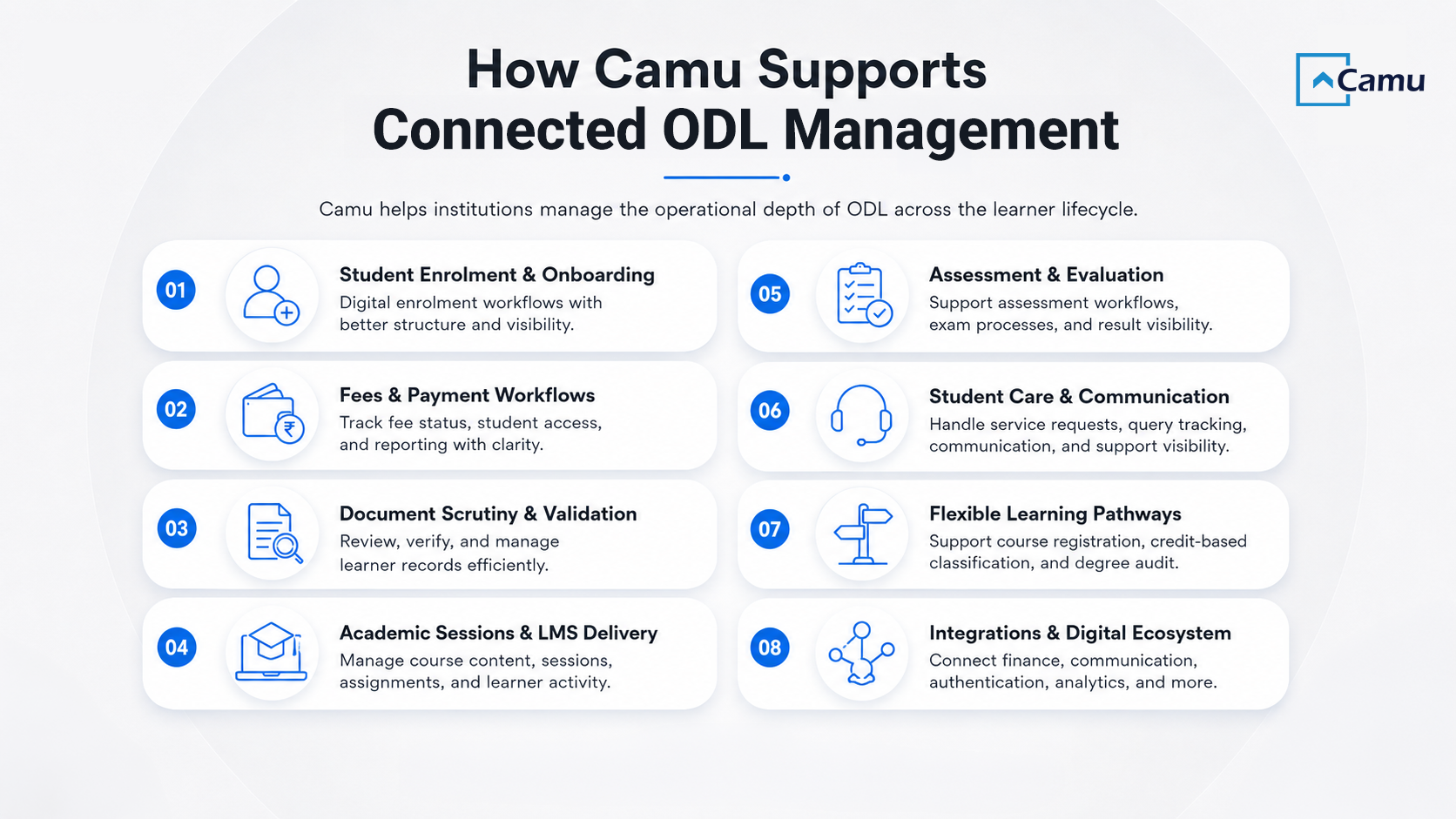
How Camu Supports Connected ODL Management
It is not positioned as only a content delivery LMS. Camu helps institutions manage the operational depth of ODL across the learner lifecycle.
1. Student Enrolment and Onboarding
Camu supports digital enrolment workflows that help institutions manage student entry into ODL programs with better structure and visibility.
This reduces manual handoffs between admissions, academic teams, and student services.
Document verification is a critical part of ODL onboarding.
Camu supports document validation workflows that help teams review, track, and manage learner records more efficiently.
4. Academic Sessions and LMS Delivery
Camu supports LMS-based academic delivery, helping institutions manage course content, learning sessions, student access, assignments, and digital learning activity.
5. Assessment and Evaluation
Camu supports ODL evaluation workflows, including assessment handling, exam-related processes, and result visibility.
This helps institutions bring more structure into distance learning evaluation.
6. Student Care and Communication
ODL learners need continuous support.
Camu supports student care workflows such as service requests, query tracking, communication, and learner support visibility.
7. Flexible Learning Pathways
Camu supports flexible enrolment and academic progression needs, including course registration, credit-based classification, and degree audit.
This helps institutions serve learners who follow different academic timelines.
8. Integrations and Digital Ecosystem Support
Camu supports integrations across institutional systems, helping ODL operations work with finance, communication, authentication, analytics, and other connected services.
Explore Camu’sOpen and Distance Learning platform to see how institutions can manage ODL through connected academic and administrative workflows.
Conclusion
Looking to manage ODL programs with connected learning, enrolment, evaluation, student care, and academic administration?
Explore Camu’sODL platform and see how your institution can build a stronger digital foundation for Open and Distance Learning.