Effective OBE implementation needs structured outcome setup, including PEOs, POs, PSOs, COs, course objectives, and program-level outcomes.
CO-PO mapping, Bloom’s taxonomy alignment, and assessment mapping are central to measuring learning outcomes accurately.
Direct and indirect attainment help institutions understand both academic performance and learner feedback.
Gap analysis turns OBE from a reporting exercise into a continuous academic improvement process.
Manual OBE management creates delays, inconsistent data, and last-minute accreditation pressure.
A connected OBE system gives academic teams better visibility, cleaner data, faster reporting, and stronger accreditation readiness.
Camu helps institutions manage OBE through structured outcome setup, CO-PO mapping, assessment linkage, attainment tracking, gap analysis, dashboards, and reports.
What Does Outcome-Based Education Mean Today?
Outcome-Based Education has become a core academic quality framework for higher education institutions. A strong outcome-based education system helps institutions answer important questions:
What should students know?
What skills should they demonstrate?
How are outcomes mapped to curriculum?
How are assessments linked to outcomes?
How is attainment measured?
What improvement actions are needed?
In simple terms, OBE connects curriculum, teaching, assessments, student performance, and continuous improvement.
But implementing OBE at scale is not simple.
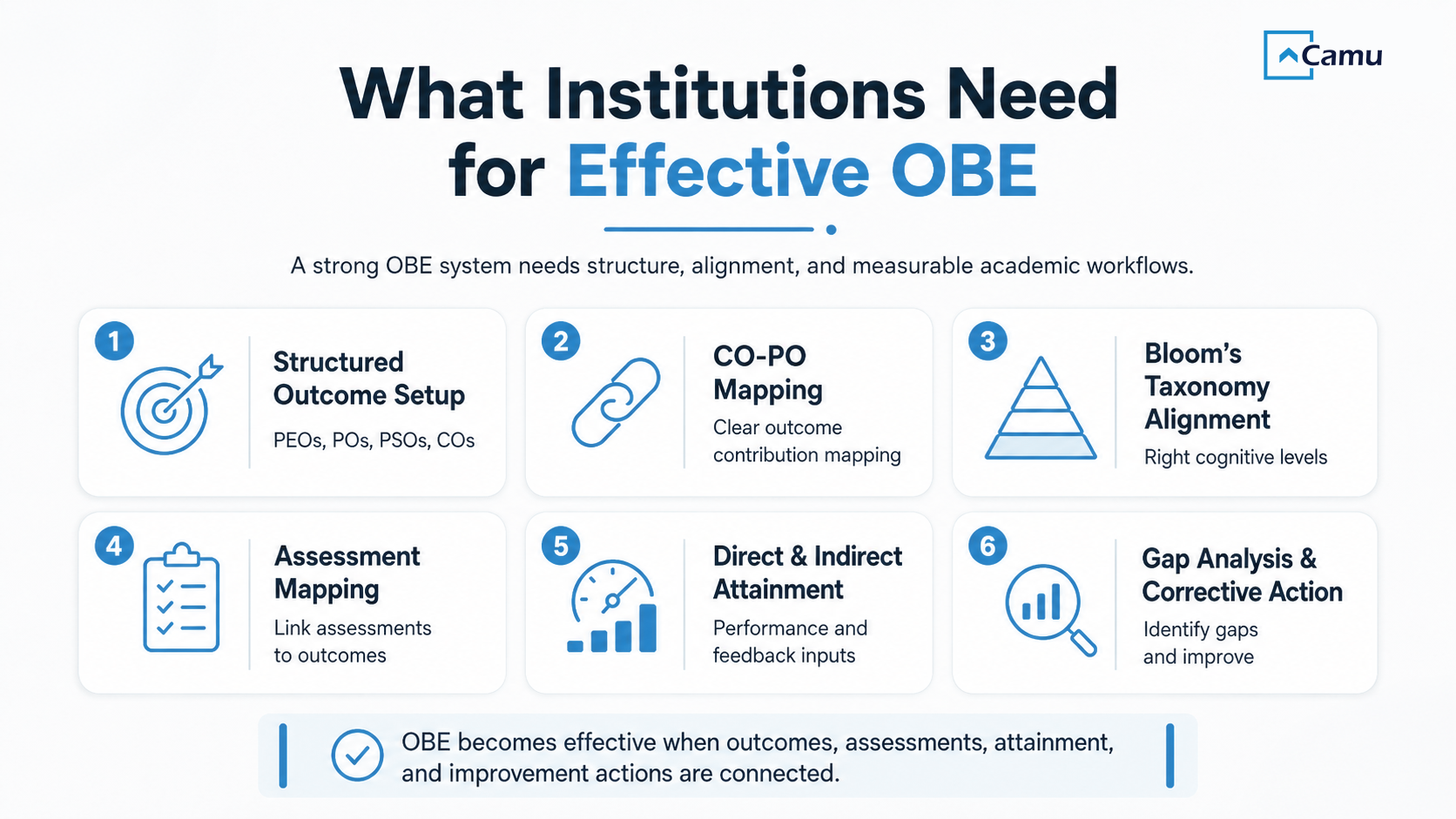
What Institutions Need for Effective OBE Implementation
1. Structured Outcome Setup
Institutions need a clear way to define and manage:
PEOs
POs
PSOs
COs
Course objectives
Program-level outcome structures
This ensures all academic teams work with a consistent framework.
2. CO-PO Mapping
CO-PO mapping is central to OBE.
It shows how course outcomes contribute to program outcomes. A connected system should make it easier to map outcomes, review mapping levels, and maintain consistency across courses and departments.
3. Bloom’s Taxonomy Alignment
Learning outcomes should reflect the right cognitive level.
For example:
Remember
Understand
Apply
Analyze
Evaluate
Create
Bloom’s taxonomy helps institutions check whether outcomes and assessments are aligned with the expected learning depth.
4. Assessment Mapping
Every assessment should connect to relevant course outcomes.
This includes:
Assignments
Quizzes
Internal exams
Lab work
Projects
Presentations
End-semester exams
Rubric-based evaluations
When assessments are mapped properly, attainment data becomes more reliable.
5. Direct and Indirect Attainment
OBE needs both direct and indirect measurement.
Direct attainment comes from student performance in assessments.
Indirect attainment may come from:
Student feedback
Course exit surveys
Alumni feedback
Employer feedback
Faculty observations
A strong OBE system should bring both into the attainment process.
6. Gap Analysis and Corrective Action
OBE should not stop at attainment calculation.
Institutions should be able to identify gaps and act on them.
For example:
Which COs are underachieved?
Which POs need academic attention?
Which courses need teaching plan changes?
Which assessments need redesign?
Which student groups need intervention?
This is where OBE becomes useful for real academic improvement
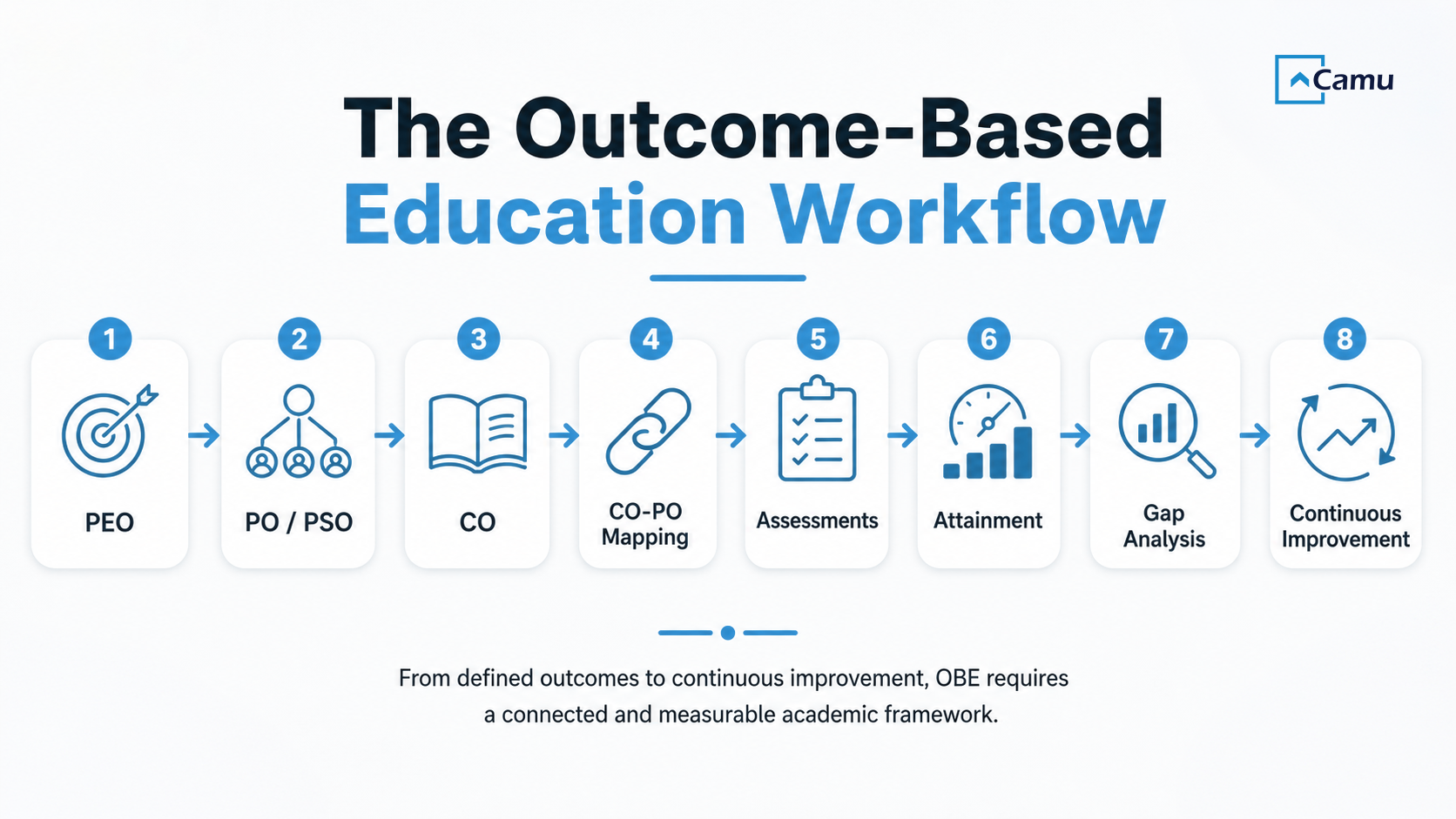
The Outcome-Based Education Workflow
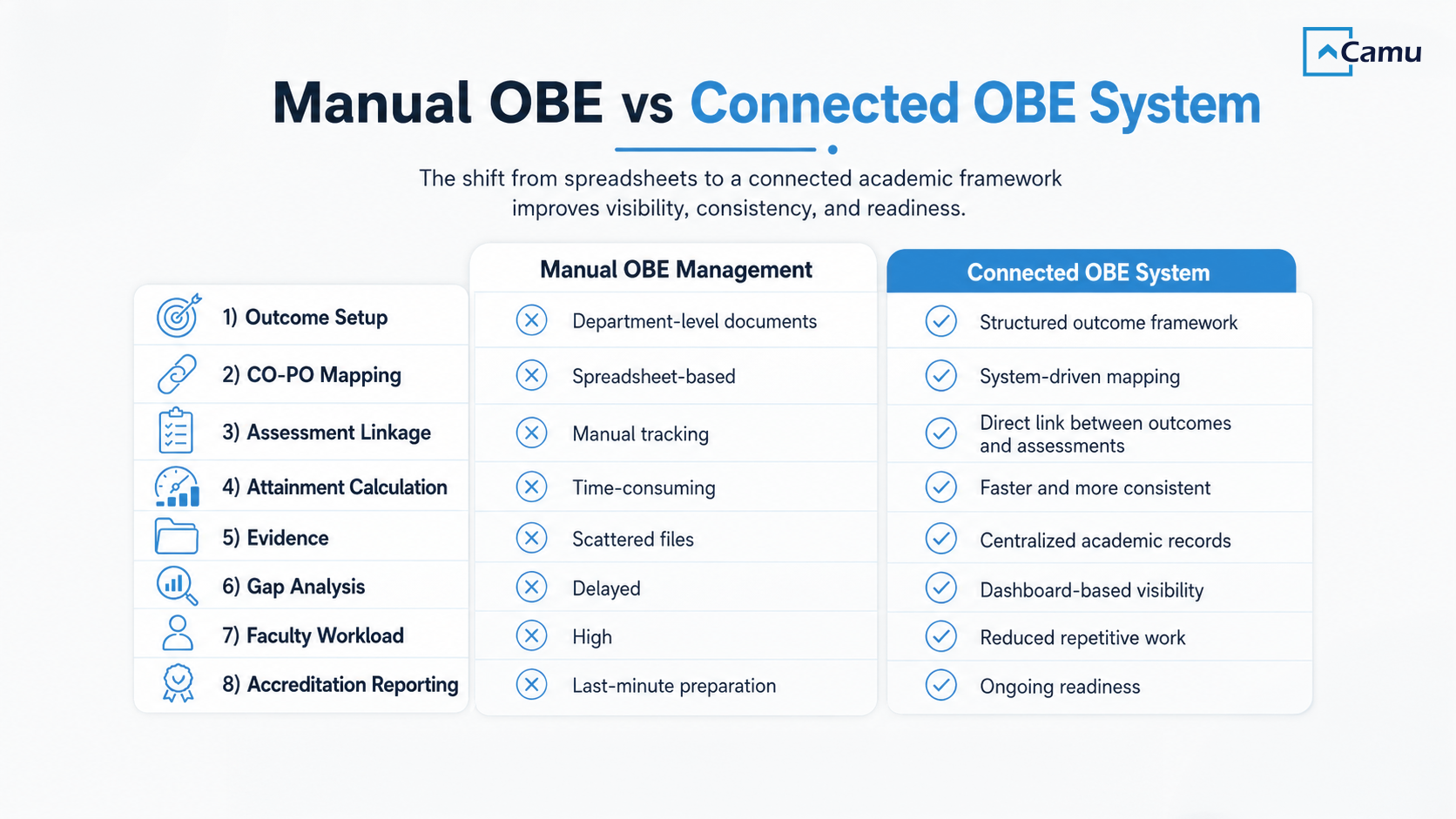
Manual OBE vs Connected OBE System
Area
Manual OBE Management
Connected OBE System
Outcome setup
Department-level documents
Structured outcome framework
CO-PO mapping
Spreadsheet-based
System-driven mapping
Assessment linkage
Manual tracking
Direct link between outcomes and assessments
Attainment calculation
Time-consuming
Faster and more consistent
Evidence
Scattered files
Centralized academic records
Gap analysis
Delayed
Dashboard-based visibility
Faculty workload
High
Reduced repetitive work
Accreditation reporting
Last-minute preparation
Ongoing readiness
A connected system does not replace academic judgment.
It supports academic teams with better structure, cleaner data, and faster reporting.
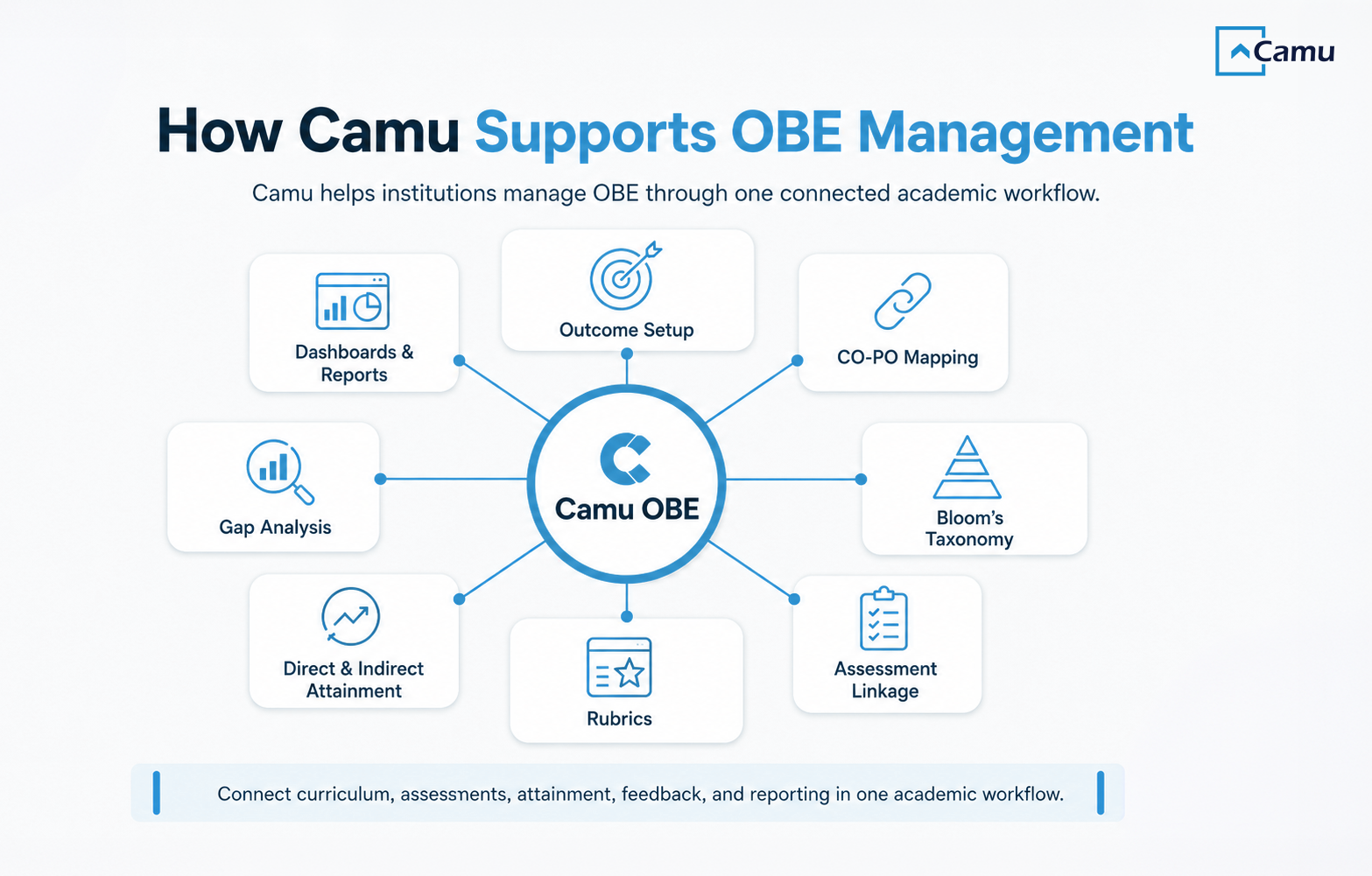
How Camu Supports Outcome-Based Education
Camu helps institutions manage OBE as a connected academic workflow.
It brings outcome setup, curriculum alignment, assessments, attainment, analytics, and quality reporting into one digital environment.
Camu’sOutcome-Based Education system helps institutions connect curriculum, assessments, attainment, feedback, and accreditation reporting in one academic workflow.
1. Outcome Definition and Setup
Camu supports structured setup of PEOs, POs, PSOs, and COs. This helps academic teams maintain consistency across programs, courses, and departments.
2. CO-PO Mapping
Camu enables institutions to map Course Outcomes to Program Outcomes and Program Specific Outcomes. This improves visibility into how each course contributes to program-level learning goals.
3. Bloom’s Taxonomy Support
Camu helps institutions align outcomes and assessments with Bloom’s taxonomy. This supports better academic design and ensures learning outcomes are mapped to the right level of cognitive complexity.
4. Assessment and Rubric Linkage
Camu connects outcomes with assessments. Institutions can link course outcomes to assignments, tests, projects, exams, and rubric-based evaluations.
This makes attainment tracking more structured and reliable.
5. Direct and Indirect Attainment
Camu supports attainment calculations using assessment performance and feedback-based inputs. This helps institutions measure both academic performance and perception-based outcome achievement.
6. Gap Analysis
Camu helps institutions identify attainment gaps across courses, programs, and outcomes. Academic leaders can use this visibility to plan corrective actions and improve teaching-learning processes.
7. Dashboards and Reports
Camu provides dashboards and reports for OBE tracking. This helps departments, deans, and quality teams review attainment, monitor progress, and prepare evidence for academic reviews and accreditation processes.
Connected OBE Is the Foundation for Better Academic Decisions
Outcome-Based Education gives institutions a clear way to measure whether students are achieving the intended learning outcomes. But the quality of OBE depends on how well the institution manages the process.
Manual systems create delays and inconsistency. Connected systems create visibility and accountability.
A strong outcome-based education system helps institutions move from isolated academic records to continuous academic improvement. Camu supports this shift by helping institutions manage outcomes, mapping, assessments, attainment, gap analysis, and reports through one connected platform.
Explore how Camu’sOutcome-Based Education system helps institutions manage CO-PO mapping, attainment, analytics, and accreditation-ready reporting.
FAQs
1. What is Outcome-Based Education?
Outcome-Based Education is an academic approach that focuses on what students should know, understand, and demonstrate by the end of a course or program. It aligns curriculum, teaching, assessments, and student performance with defined learning outcomes.
2. What is CO-PO mapping in OBE?
CO-PO mapping is the process of linking Course Outcomes to Program Outcomes. It helps institutions understand how each course contributes to broader program-level graduate outcomes.
3. How is OBE attainment calculated?
OBE attainment is usually calculated using direct and indirect methods. Direct attainment comes from assessment performance. Indirect attainment comes from feedback, surveys, and other perception-based inputs.
4. Why do institutions need OBE software?
Institutions need OBE software to reduce manual work, improve consistency, calculate attainment faster, track evidence, identify gaps, and prepare accreditation-ready reports.
5. How does OBE support accreditation?
OBE supports accreditation by providing structured evidence for curriculum alignment, assessment quality, student performance, attainment, feedback, gap analysis, and continuous improvement.
6. How does Camu help with Outcome-Based Education?
Camu helps institutions manage OBE through outcome setup, CO-PO mapping, Bloom’s taxonomy alignment, assessment linkage, direct and indirect attainment, gap analysis, dashboards, and accreditation-ready reports.