Institutions need to track eligible students, active job seekers, unique placements, offer acceptance, joining status, and role relevance.
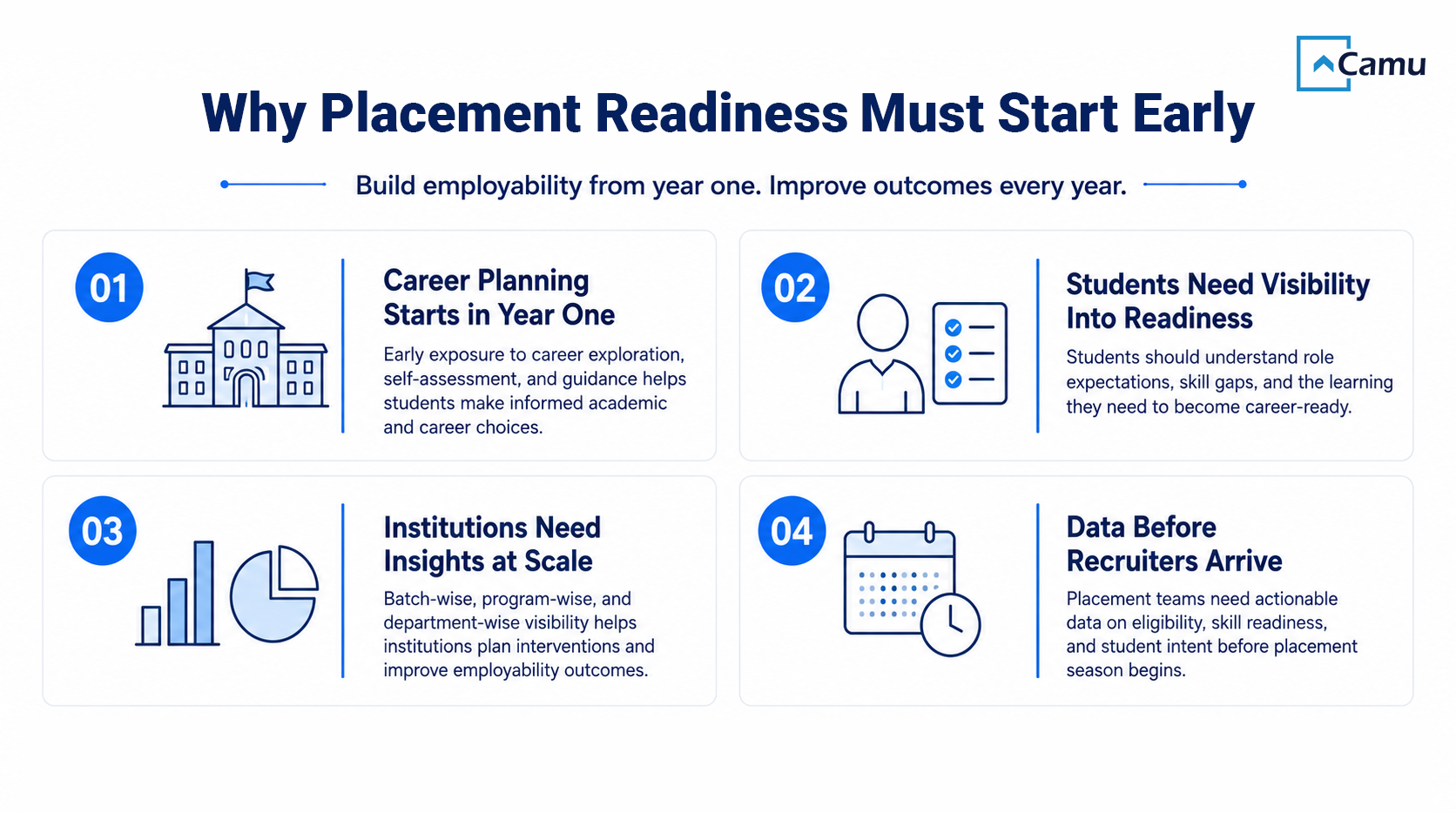
Career readiness should be tracked from year one, not only during final-year placement drives.
Skill gaps remain a major employer concern, making readiness tracking important for colleges and universities.
Camu helps institutions connect student records, profiling, market intelligence, AI job matching, applications, offers, and dashboards.
What Does Better Placement Management Mean Today?
For institutional leaders, the better question is not only: How many offers did the institution receive?
The stronger question is: How many students were prepared, matched, placed, and moved into relevant career outcomes?
India’s higher education system operates at a massive scale. AISHE 2021-22 reported total enrolment of nearly 4.33 crore students in higher education. At this scale, employability tracking cannot depend on spreadsheets, manual follow-ups, and final-year placement drives alone.
Need Help Growing Your Business Online?
Discover expert digital solutions, guidance, and support tailored for your business goals.
Why Placement Reporting Breaks Down in Higher Education
Recent LinkedIn discussions around college placements in India have raised a practical concern: placement reports often highlight offer numbers, but do not always explain how many students secured meaningful employment.
A stronger placement report should answer:
How many students were eligible for placements?
How many were active job seekers?
How many opted for higher studies, entrepreneurship, or other pathways?
How many unique students received offers?
How many students received multiple offers?
How many offers were accepted?
How many students joined?
Were the roles relevant to the student’s academic program?
Without this context, offer counts become difficult to interpret. A college or university may show a high number of offers, but leadership still needs to know whether the institution is improving employability, role relevance, and Graduate-to-Employment outcomes.
Why Career Readiness Must Begin Before Placement Season
Many institutions begin serious placement preparation only in the final year. By then, placement teams have limited time to close gaps in technical skills, communication, interview confidence, certifications, portfolio readiness, aptitude, and role clarity.
Employer expectations are also shifting. The World Economic Forum’s Future of Jobs Report 2025 identifies skill gaps as the biggest barrier to business transformation. The report notes that 63% of employers see skill gaps as a major barrier during 2025 to 2030. NACE also reports that 70% of employers in its Job Outlook 2026 survey use skills-based hiring, up from 65% the previous year.
For institutions, this means placement readiness needs to start earlier. Career readiness should be visible from year one through profiling, skill-gap tracking, career guidance, mentorship, learning recommendations, and employer-aligned preparation.
Fragmented Student and Employer Data
Placement teams often work with disconnected data.
Academic records may sit in the SIS. Learning performance may sit in the LMS. Attendance may be managed elsewhere. Skill data may be maintained by training teams. Employer details may remain in spreadsheets.
This creates delays in eligibility validation, shortlisting, recruiter communication, interview scheduling, test coordination, offer tracking, and outcome reporting.
When data is fragmented, placement teams spend more time collecting information than improving outcomes.
Need Help Growing Your Business Online?
Discover expert digital solutions, guidance, and support tailored for your business goals.
Institutions need visibility before, during, and after placement season.
Before placements, they need to know which students are ready, which students need support, and which skills are missing.
During placements, they need to manage applications, assessments, interviews, shortlists, and recruiter communication.
After placements, they need to track offer acceptance, joining status, role relevance, and department-wise outcomes.
How Camu helps Institutions build Career Readiness from the beginning
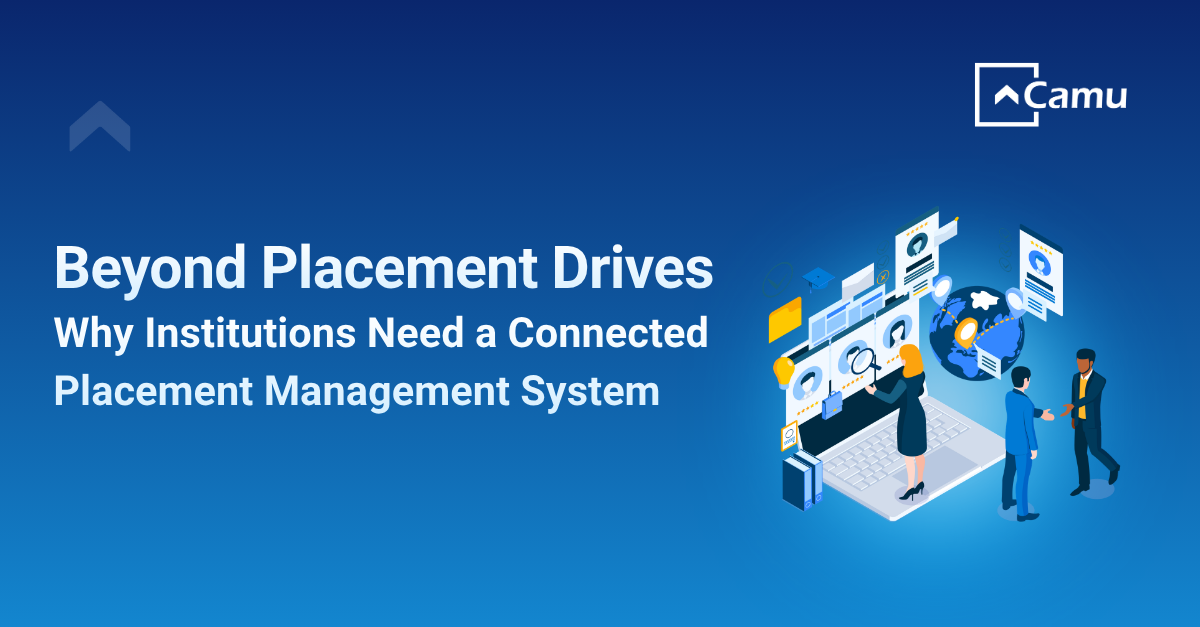
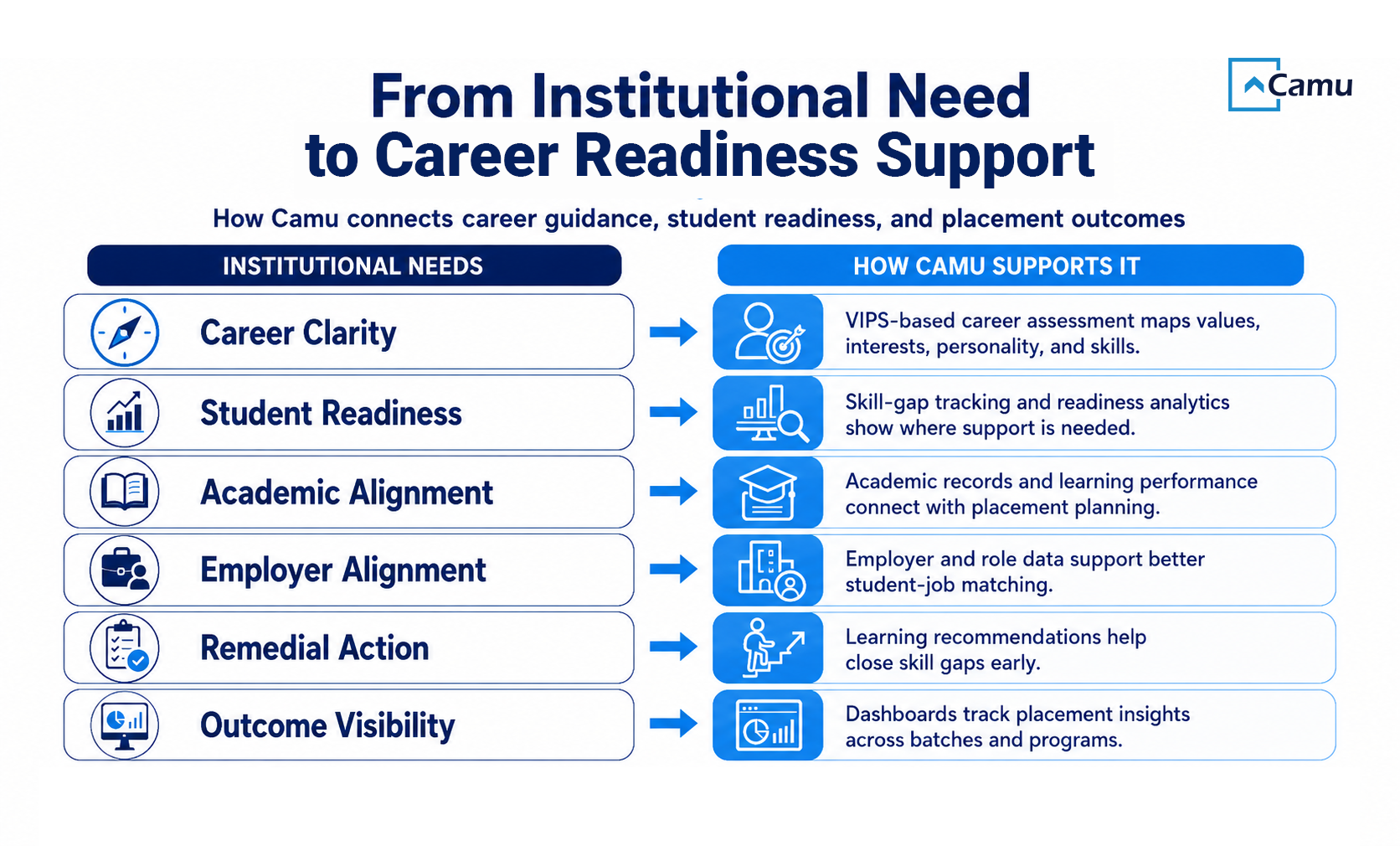
Camu’s Placement Management software helps colleges and universities guide students from enrolment to employment by connecting student records, career profiling, skill-gap analytics, market intelligence, AI job matching, applications, offers, and dashboards.
1. Unified Student Intelligence Layer
Camu brings together student records, academic data, learning performance, and employer information into one connected layer.
For placement teams, this creates a trusted base for eligibility checks, readiness tracking, student profiling, and recruiter alignment.
For leadership, it creates visibility across the career journey, instead of relying on separate reports from departments, placement cells, and training teams.
2. VIPS-Based Career Profiling
Camu uses the VIPS framework to support structured career profiling.
VIPS stands for Values, Interests, Personality, Skills.
This helps institutions guide students based on a broader view of potential, not only marks or resume details.
Students can identify suitable career paths based on interests, motivations, personality fit, current skills, academic records, and labour market demand.
3. Dream Job Readiness Dashboard
Camu provides a Dream Job readiness dashboard that helps track how close students are to their preferred career path.
For institutions, this turns career planning into a measurable process.
Placement teams and faculty can see skill gaps, certification needs, recommended learning actions, and readiness progress earlier in the student lifecycle.
4. Skill-Gap Analytics and Remedial Learning
Camu identifies specific skill deficiencies and supports remedial learning recommendations through Camu Engage.
This helps institutions act before placement season begins.
Instead of discovering readiness gaps when recruiters start shortlisting, placement teams and faculty can intervene earlier with targeted learning support.
5. Market Intelligence for Career and Curriculum Alignment
Camu connects career guidance with labour market intelligence.
The platform uses integrations with O*NET, IPEDS, and BLS to align career planning with job demand, growth trends, salary benchmarks, emerging roles, and declining roles.
For colleges and universities, this has direct strategic value. It helps leadership and academic teams understand whether curriculum, skill programs, internships, and career guidance are aligned with actual market demand.
6. AI-Driven Job and Internship Matching
Camu supports job and internship matching using academic data, psychometric data, occupational data, and market intelligence.
This helps placement teams move beyond generic resume forwarding.
The focus shifts to better student-role fit.
A relevant placement is not only about whether a student received an offer. It is about whether the role aligns with the student’s skills, interests, academic background, and career goals.
7. Outcome Dashboards Beyond Placement Counts
Camu helps institutions measure placement outcomes through more meaningful indicators. These include:
Graduate-to-Employment ratio
Skill readiness progression
Curriculum alignment with market demand
Student engagement with career planning tools
Employer and role alignment
Batch-wise and program-wise employability insights
Career Readiness Is the New Placement Metric
Placement reports need more than offer counts. Colleges and universities need to know whether students were ready, roles were relevant, offers were accepted, and outcomes were measurable. Camu helps institutions connect career profiling, skill-gap analytics, market intelligence, AI job matching, applications, offers, and dashboards into one placement ecosystem.
Explore how Camu can help your institution strengthen career readiness and placement outcomes.