Key Takeaways
Cloud SIS generally offers lower upfront infrastructure costs, easier remote access, and reduced IT management responsibilities.
On-premises SIS provides greater infrastructure control but requires dedicated IT resources, ongoing maintenance, and security management.
Philippine colleges should compare five key factors: total cost of ownership, IT responsibility, security, data privacy, and scalability.
Both deployment models must comply with the Philippine Data Privacy Act of 2012, with institutions remaining accountable for personal data protection.
Internet reliability, institutional infrastructure, operational requirements, and long-term growth plans should guide the final deployment decision.
For most Philippine colleges, cloud deployment offers a simpler operating model, especially for institutions looking for lower upfront infrastructure costs, easier remote access, faster implementation, and less pressure on internal IT teams. But the right choice depends on your institution’s budget, IT capacity, connectivity, security requirements, and plans for growth.
With over a decade of experience delivering cloud-based education technology, Camu has worked with institutions across diverse academic models, regulatory environments, and operational requirements.
This experience offers practical insights into the infrastructure, scalability, accessibility, and long-term support considerations institutions face when choosing an SIS.
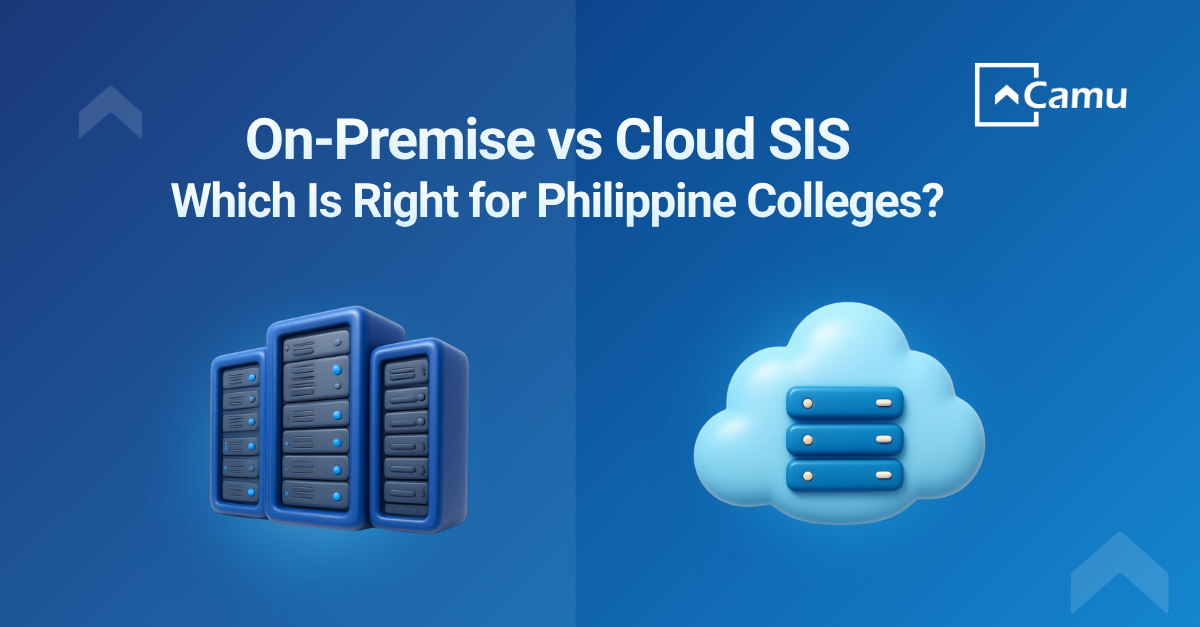
On-Premises vs Cloud SIS: At a Glance
| On-Premises SIS | Cloud SIS |
| Initial investment | Higher infrastructure investment | Lower upfront infrastructure investment |
| Infrastructure | Managed by the institution | Managed by the provider |
| Maintenance | Internal IT responsibility | Primarily provider responsibility |
| Updates | Planned and managed by the institution | Typically managed by the provider |
| Backups | Institution responsibility | Typically handled by the provider |
| Remote access | Requires appropriate institutional setup | Designed for access through the internet |
| Scalability | Requires additional infrastructure | Easier to scale with demand |
| Peak registration | Infrastructure must support peak demand | Greater flexibility during demand peaks |
| IT workload | Higher | Lower infrastructure burden |
| Cost model | Higher CAPEX | Recurring OPEX |
| Disaster recovery | Institution must maintain the capability | Provider typically manages redundancy and recovery |
| Product improvements | Institution manages upgrades | Provider manages ongoing improvements |
The core difference is simple: an on-premises SIS gives the institution more responsibility for the technology environment, while a cloud SIS shifts much of that infrastructure responsibility to the provider.
The Five Factors Philippine Colleges Should Compare
1. Total Cost of Ownership
For an on-premises SIS, consider servers, storage, networking, power, backups, maintenance, software updates, IT staffing, and hardware replacement. Cloud SIS generally shifts the financial model from upfront capital expenditure to recurring operating expenditure.
Colleges should evaluate the five-year total cost of ownership, infrastructure expenses beyond the software licence, and financial responsibilities for upgrades and additional capacity.
2. IT Responsibility
With on-premises deployment, your IT team manages the infrastructure supporting the SIS. With cloud deployment, the provider takes on much of this responsibility.
This matters particularly for colleges with lean IT teams. Cloud is often a better fit when the institution wants to reduce infrastructure management and focus IT resources on institutional priorities.
3. Security
On-premises deployment does not automatically mean greater security. Local hosting gives the institution physical control over its infrastructure, but the institution also assumes responsibility for security, patching, backups, access controls, and disaster recovery.
Cloud providers typically offer specialised security infrastructure, monitoring, redundancy, and automated backups. However, colleges must evaluate the provider's security controls, privacy practices, and contractual commitments.
4. Data Privacy
Under Republic Act No. 10173 (Data Privacy Act of 2012), Philippine colleges remain
accountable for personal data protection regardless of the SIS deployment model.
Institutions must evaluate security safeguards, data processing agreements, hosting
arrangements, access controls, breach notification procedures, and disaster recovery
capabilities to support regulatory compliance.
5. Scalability and Peak Demand
Registration periods can create sudden increases in system usage.An on-premises environment needs enough infrastructure to handle those peaks. Increasing capacity requires additional hardware and infrastructure planning.
Cloud environments provide greater flexibility to handle changing demand without requiring the institution to maintain equivalent physical capacity on campus.
What About Internet Reliability?
This is one area where Philippine colleges need to evaluate their own environment carefully. Cloud SIS depends on reliable internet connectivity for day-to-day access.
If your campus experiences frequent connectivity problems, evaluate Internet redundancy, backup connectivity, mobile access options, provider uptime commitments, and business continuity and recovery processes.
An institution should not reject cloud deployment based on connectivity alone. It should assess whether its network infrastructure and the provider's availability strategy meet the needs of its operating environment.
When Should Colleges Choose On-Premises or Cloud SIS?
| S. No | On-premises SIS may be suitable when | Cloud SIS may be suitable when |
| 1 | The institution has established data centre infrastructure. | The institution wants to reduce upfront infrastructure costs. |
| 2 | A dedicated IT team manages security and maintenance. | Internal IT resources are limited. |
| 3 | Internal policies require local hosting or infrastructure control. | Students and staff require off-campus access. |
| 4 | Reliable external connectivity is a significant constraint. | The institution expects growth or changing capacity requirements. |
Camu as an Established Cloud SIS Provider
Camu supports over 600 educational institutions globally, serving approximately one million students across diverse academic environments. Its experience spans universities, autonomous colleges, multi-campus institutions, and digital-first education providers.
Octoze (Camu) has been recognised as a Niche Player in the 2026 Gartner® Magic Quadrant™ for Higher Education SaaS Student Information Systems.
A Philippine Cloud SIS Success Story: Mapúa Malayan Digital College
Mapúa Malayan Digital College (MMDC) partnered with Camu to support its fully online education model through a unified Student Information System and Learning Management System. The implementation supports centralised academic administration, digital learning delivery, student accessibility, and institutional workflows within a connected platform.
“The platform is user-friendly, intuitive, and easy to master in just a few training sessions. What is important to note is that this has helped increase our team productivity.”
— Chester Catilago, Director, Center for Education Innovation, Mapúa Malayan Digital College, Philippines.
The Bottom Line: Making the Right SIS Choice
Compare infrastructure costs, IT responsibilities, internet requirements, security controls, data privacy, scalability, accessibility, update processes, and long-term support.
For many Philippine colleges, cloud SIS offers a practical route to modernising student administration without taking on the infrastructure burden of running an on-premises system.
If your institution is evaluating a new SIS, book a demo with Camu to explore how a cloud-based SIS can support your academic and administrative workflows.
Frequently Asked Questions
1. What is the difference between a cloud-based SIS and an on-premises SIS?
A cloud-based SIS is hosted by a service provider and accessed through the internet. An on-premises SIS is installed on institution-managed infrastructure, requiring internal resources for maintenance, security, backups, and upgrades.
2. Is a cloud-based SIS cheaper than an on-premises SIS?
Cloud SIS generally requires lower upfront infrastructure investment. However, long-term costs depend on subscription fees, implementation, integrations, and support. Colleges should compare the five-year total cost of ownership of both models.
3. Is student data safe in a cloud-based SIS?
Data security depends on the provider’s encryption, access controls, security monitoring, backup procedures, and incident response practices. Philippine colleges must also ensure compliance with the Data Privacy Act of 2012.
4. What happens to a cloud-based SIS if the internet goes down?
Users may temporarily lose access to the system. Colleges should maintain backup internet connections and business continuity procedures to minimise operational disruptions. Offline functionality depends on the SIS provider.