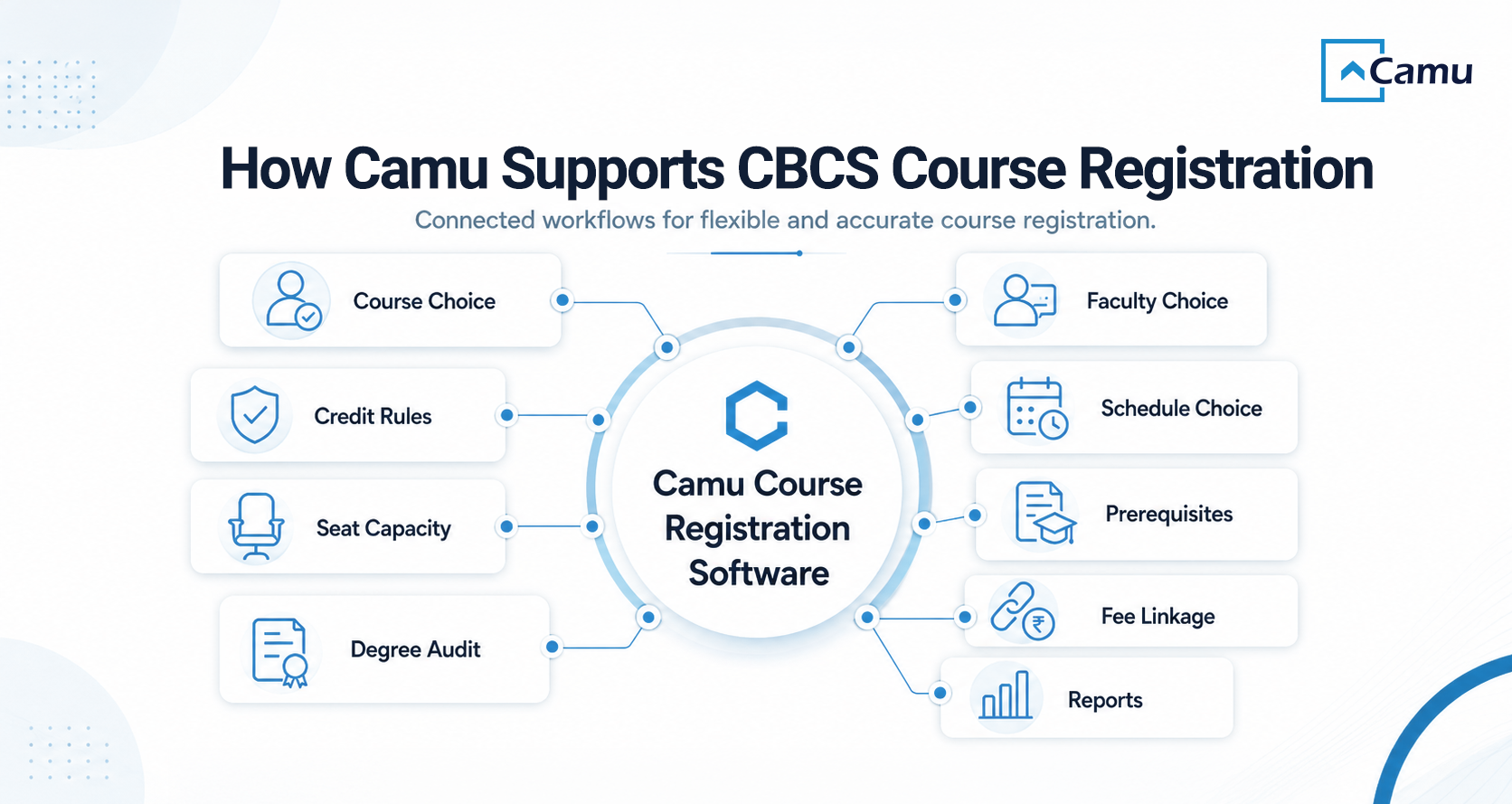
Rathinam and Saveetha Engineering College show how CBCS works better when supported by connected digital workflows.
Camu helps institutions manage CBCS through course registration, rule validation, credit tracking, timetable conflict checks, seat management, and degree audit.
What CBCS Means for Higher Education Today
The Choice-Based Credit System, or CBCS, gives students more control over their academic journey.
Students can choose courses based on their interests, career goals, credit requirements, and academic plans. This supports interdisciplinary learning, flexible progression, and more personalized education.
But for institutions, CBCS is not only about offering more course options.
Every student choice must connect with academic rules, timetable slots, faculty availability, seat capacity, credit limits, fee rules, and degree completion requirements.
This is where CBCS becomes an academic operations challenge.
Camu’s course registration software helps institutions manage student course choices, credit rules, timetable checks, seat capacity, and degree audit in one connected workflow.
Why CBCS Needs More Than Manual Registration
CBCS gives students flexibility. But institutions need structure to manage that flexibility.
When CBCS is handled manually, academic teams often depend on spreadsheets, emails, forms, and department-level approvals. This creates delays and increases the chance of errors.
Common challenges include:
Managing course choices across departments
Validating minimum and maximum credit limits
Checking prerequisites and co-requisites
Avoiding timetable clashes
Managing seat capacity
Coordinating faculty allocation
Linking registration with fees
Tracking completed and pending credits
Ensuring degree audit readiness
Without the right system, students may register for ineligible courses, face timetable conflicts, exceed credit limits, or miss required courses for graduation.
This affects both student experience and academic governance.
What Course Registration Software Should Manage for CBCS
A strong course registration software should help institutions manage CBCS with accuracy, visibility, and control.
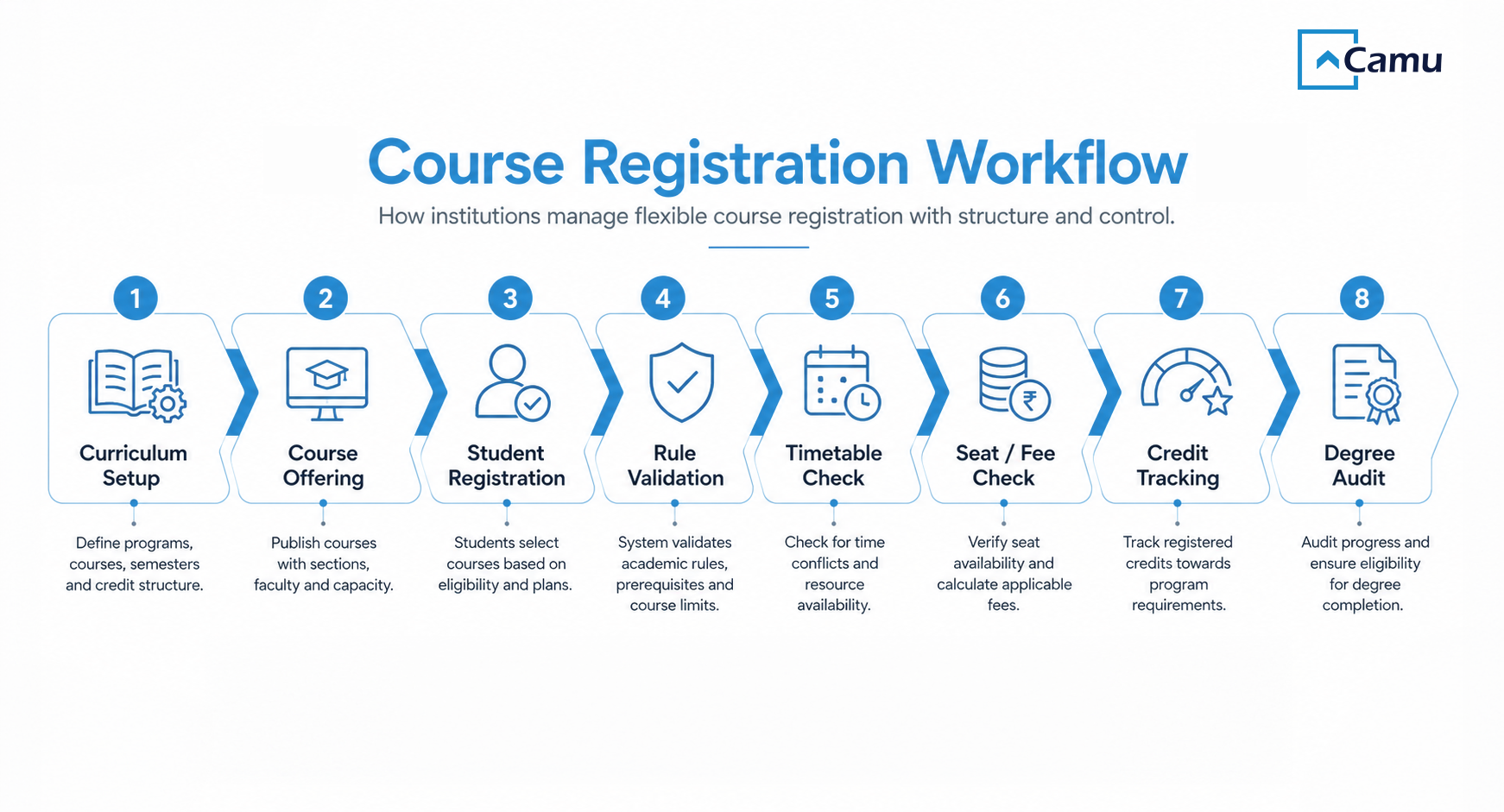
It should support the full registration workflow, from curriculum setup to degree audit.
1. Curriculum and Course Setup
Institutions need to define programs, semesters, course baskets, electives, credits, and academic rules clearly.
This creates the foundation for structured CBCS registration.
2. Course Offering
Departments should be able to publish courses with faculty, sections, seat limits, timetable slots, and availability.
This helps students view the right courses during registration.
3. Student Course Registration
Students need a guided digital process to select eligible courses.
The system should show available options, credits, faculty, schedules, and registration status.
4. Rule Validation
CBCS needs automated academic rule checks.
This includes:
Credit limits
Prerequisites
Co-requisites
Eligibility rules
Course group requirements
Program rules
5. Timetable Conflict Detection
Students should be alerted when selected courses clash.
This helps avoid late corrections and registration rework.
6. Seat and Fee Checks
Institutions need live visibility into seat availability and fee-linked workflows.
This helps manage demand, allocation, and payment-related registration rules.
7. Credit Tracking
Students and academic teams need visibility into registered credits, completed credits, pending credits, and program requirements.
This supports progression tracking.
8. Degree Audit
CBCS should connect with the degree audit.
Institutions need to know whether students have met all academic requirements for graduation.
CBCS in Practice: Rathinam Group of Institutions and Saveetha Engineering College
CBCS becomes meaningful when institutions can manage it at scale.
In their customer story, Dr. Madan A. Senthil, Chairman of Rathinam Group, speaks about how the institution adopted technology early and moved toward a flexible academic model. Rathinam uses Camu to support CBCS workflows such as academic planning, student course choices, enrolment, and assessment processes.
With 7,000+ students across 8 semesters, Saveetha manages a flexible CBCS model where students select courses based on academic plans and mentor guidance.
Their CBCS process includes:
Courses offered by semester
Faculty and slot planning
Student course selection
Mentor feedback
Phased enrolment
Seat allocation
Timetable generation
These examples show that CBCS needs more than policy-level flexibility. It needs a digital system that can manage course choice, academic rules, credits, seats, timetables, and student progression.
How Camu Supports CBCS Management
Camu helps institutions manage CBCS through connected academic workflows.
This helps institutions offer flexibility without increasing manual workload.
Conclusion
CBCS gives students the flexibility to shape their academic journey. But institutions need the right systems to manage that flexibility with accuracy and control.
Explore Camu’s online course registration software to manage CBCS with structured course registration, credit validation, timetable checks, seat management, and degree audit.
FAQs
1. What is CBCS in higher education?
CBCS, or Choice-Based Credit System, is an academic model that allows students to choose courses and earn credits based on program requirements, interests, and career goals.
2. Why does CBCS need online course registration software?
CBCS needs course registration software because institutions must manage student choices, credit limits, prerequisites, timetable conflicts, seat availability, and degree completion requirements at scale.
3. What features should course registration software include?
Course registration software should include course offering, student registration, credit validation, prerequisite checks, timetable conflict alerts, seat capacity management, fee linkage, credit tracking, degree audit, and reports.
4. How does course registration software prevent timetable conflicts?
Course registration software checks selected courses against timetable slots and alerts students or administrators when there is a clash.
5. How does Camu support CBCS course registration?
Camu supports CBCS course registration through digital course selection, rule validation, credit tracking, timetable conflict checks, seat capacity management, fee linkage, degree audit, and dashboards.