Key Takeaways
CAA accreditation in the UAE is moving toward a more outcomes-based approach.
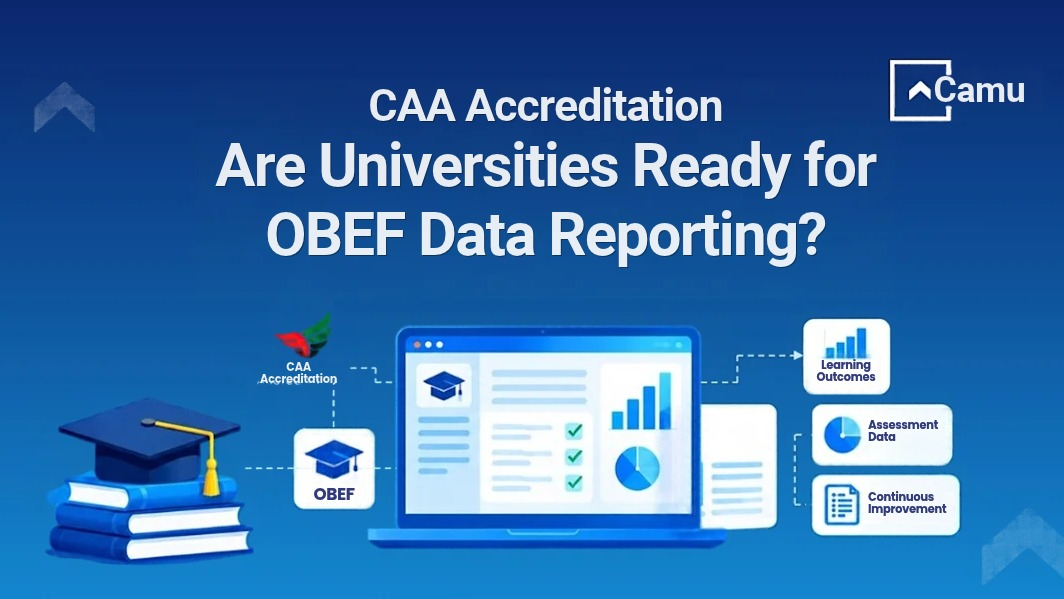
The Outcomes-Based Evaluation Framework, OBEF, evaluates institutions through 24 KPIs across six outcome areas.
Several KPIs depend on multi-year data, making continuous data management important.
Universities need connected systems to maintain reliable academic and institutional data.
Camu helps UAE institutions connect academic data, OBE, assessments, attendance, analytics, and reporting.
CAA Accreditation Is Becoming More Data-Driven
CAA accreditation in the UAE is evolving toward a stronger focus on measurable institutional outcomes. The current approach uses the Outcomes-Based Evaluation Framework, OBEF, which evaluates higher education institutions through defined KPIs and outcome areas.
This changes how universities need to think about accreditation readiness.
The question is no longer only whether an institution has the required processes and documentation. Universities also need reliable data to demonstrate how they are performing and how outcomes are changing over time.
This makes data readiness an important part of CAA accreditation readiness.
What Is the Outcomes-Based Evaluation Framework?
The OBEF evaluates institutions across six pillars:
OBEF Pillar |
Weight |
| Employment Outcomes | 25% |
| Learning Outcomes | 25% |
| Industry Collaboration | 20% |
| Research Outcomes | 15% |
| Reputation | 10% |
| Community Engagement | 5% |
Together, these pillars contain 24 KPIs covering areas such as graduate employment, learning experience, industry engagement, research, international collaboration, reputation, and community engagement.
The framework therefore looks across different parts of university operations rather than relying on one source of information.
Why Data Readiness Matters
OBEF makes historical data important. The current framework uses different measurement periods for different KPIs. Some rely on previous-year data, while others use three-year or five-year rolling averages or cumulative five-year data.
This means universities cannot wait until an accreditation review is approaching to start gathering evidence. They need to maintain reliable information throughout the academic cycle. That includes data related to:
Student enrolment and progression
Academic performance and assessments
Learning outcomes
Graduate employment
Industry collaboration
Research
Student experience
Institutional performance
The challenge is therefore bigger than collecting data. Universities need to keep this information consistent, accessible, and ready for analysis.
From Data Collection to Connected Data
Different institutional outcomes come from different departments and systems.
Academic records may sit within the SIS. Learning activity may sit within the LMS. Attendance and assessment information may be managed through separate academic workflows. Employment, research, and industry information may come from other institutional sources.
When these systems operate separately, teams often need manual consolidation before they can produce a complete view.
A connected digital environment helps bring relevant information together.
The goal is not to automate CAA accreditation. It is to give institutions a stronger data foundation for monitoring outcomes, preparing reports, identifying gaps, and supporting continuous improvement.
Are Universities Ready for Continuous OBEF Data Reporting?
Universities can start by asking a few practical questions:
Can we access historical institutional data easily?
Is academic information consistent across departments?
Can we connect student, learning, attendance, and assessment data?
Can we produce institutional reports without repeatedly consolidating spreadsheets?
Can we monitor KPI performance between accreditation cycles?
Can we identify performance gaps early?
These questions point to a broader shift.
CAA accreditation readiness is becoming part of ongoing institutional data management rather than a task that begins shortly before an evaluation.
The UAE's direction also reflects this shift. In 2026, MOHESR launched the Higher Education Institutions Indicators Compass to support OBEF performance monitoring, data quality, benchmarking, and institutional improvement.
How Technology Supports CAA Accreditation Readiness
Technology does not replace an institution's quality processes. It provides the infrastructure needed to manage the information behind them.
A connected higher education platform can help institutions bring together:
Camu supports this connected approach for UAE higher education institutions through its SIS, LMS, OBE, assessment, attendance, analytics, and reporting capabilities. Its UAE offering also supports CLO and PLO tracking, OBE dashboards, and institutional reporting.
This gives institutions a more connected foundation for managing academic information and monitoring outcomes throughout the academic cycle.
CAA Accreditation Readiness Starts With Data Readiness
The shift toward outcomes-based evaluation changes how universities need to approach institutional readiness.
OBEF requires institutions to demonstrate measurable outcomes across employment, learning, industry collaboration, research, reputation, and community engagement. Several indicators also depend on historical performance data. For universities, the priority is therefore not only collecting information when reporting is due. It is maintaining connected, reliable, and accessible institutional data throughout the year.
Explore how Camu's UAE higher education solutions support connected academic management, OBE, analytics, and institutional reporting.
Frequently Asked Questions
1. What is CAA accreditation in the UAE?
CAA accreditation is part of the UAE's higher education quality assurance framework. The current approach places greater emphasis on outcomes, measurable performance, digitalisation, and defined KPIs.
2. What is OBEF?
OBEF stands for Outcomes-Based Evaluation Framework. It evaluates higher education institutions across six pillars and 24 KPIs.
3. Why is data important for OBEF?
Several OBEF indicators use multi-year performance data. Universities therefore need consistent and reliable data collection throughout the academic cycle.
4. How does Camu support UAE universities?
Camu connects SIS, LMS, OBE, assessments, attendance, analytics, and reporting to help institutions manage academic information through connected digital workflows.