Fee Management System challenges often begin with delayed collections, unclear payment status, and fragmented financial records.
Institutions need more than online payment access; they need structured billing, reminders, receipts, reconciliation support, and student-side visibility.
India’s higher education ecosystem serves nearly 4.33 crore students, making fee management a scale-sensitive institutional function.
With UPI accounting for 81% of retail digital payments in FY 2024–25, digital-first fee visibility has become essential.
Camu connects staff-side billing workflows with student-side payment transparency, helping institutions improve financial control and student experience.
What Does Better Fee Management System Mean Today?
Collecting payments is no longer the only aspect of fee management. Fee setup, billing schedules, invoices, payment reminders, penalties, receipts, refunds, discounts, online transactions, and student account statements are all included for higher education institutions.
A contemporary fee management method ought to assist both parties.
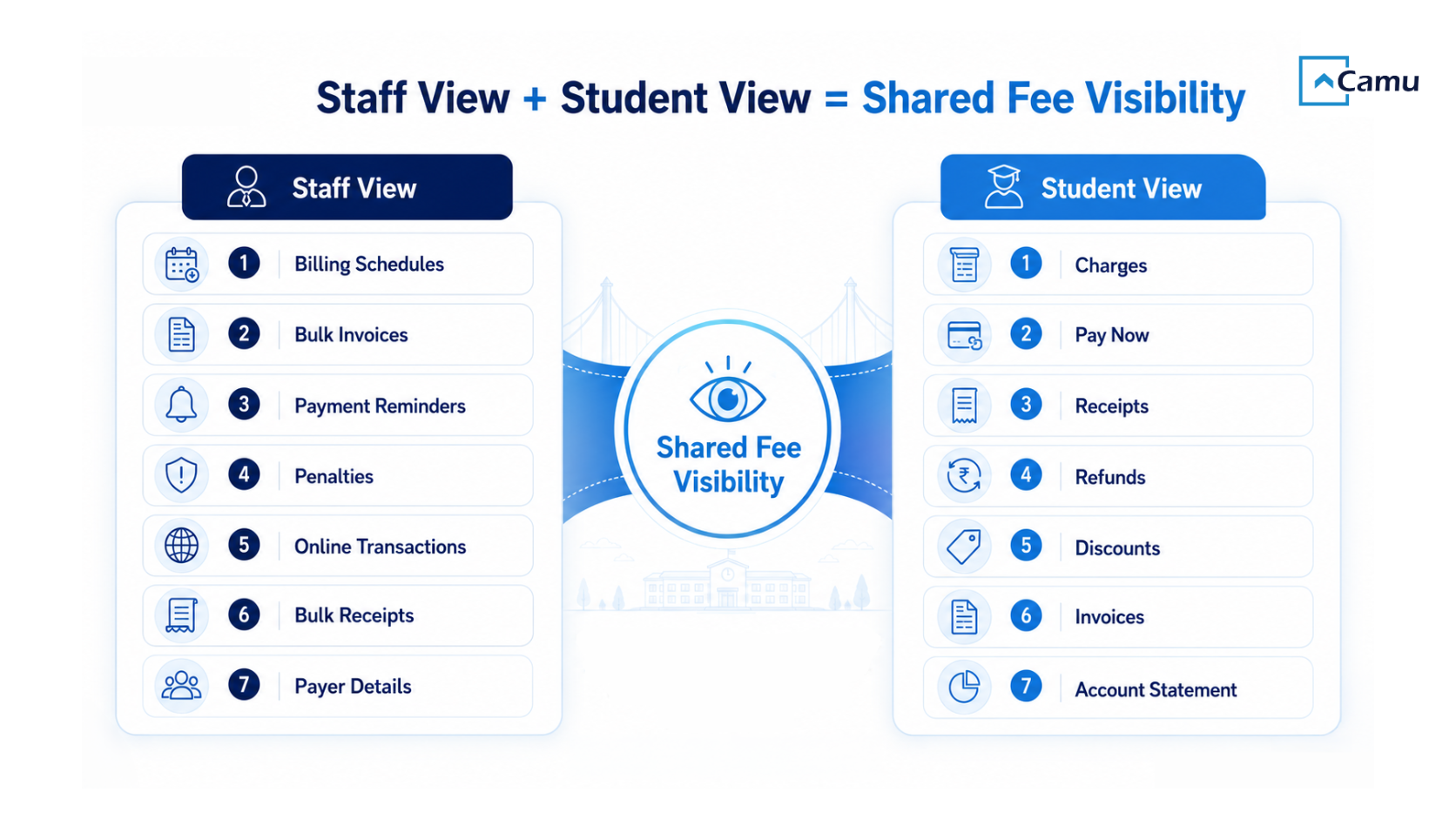
Control over billing, collections, reminders, receipts, fines, and payment records should be made available to institutions.
Charges, paid and unpaid status, receipts, refunds, invoices, credit balance, and overdue amount should all be visible to students.
Fee operations become more structured, transparent, and manageable when both parties adopt the same financial perspective.
Why Fee Management Systems Break Down in Higher Education
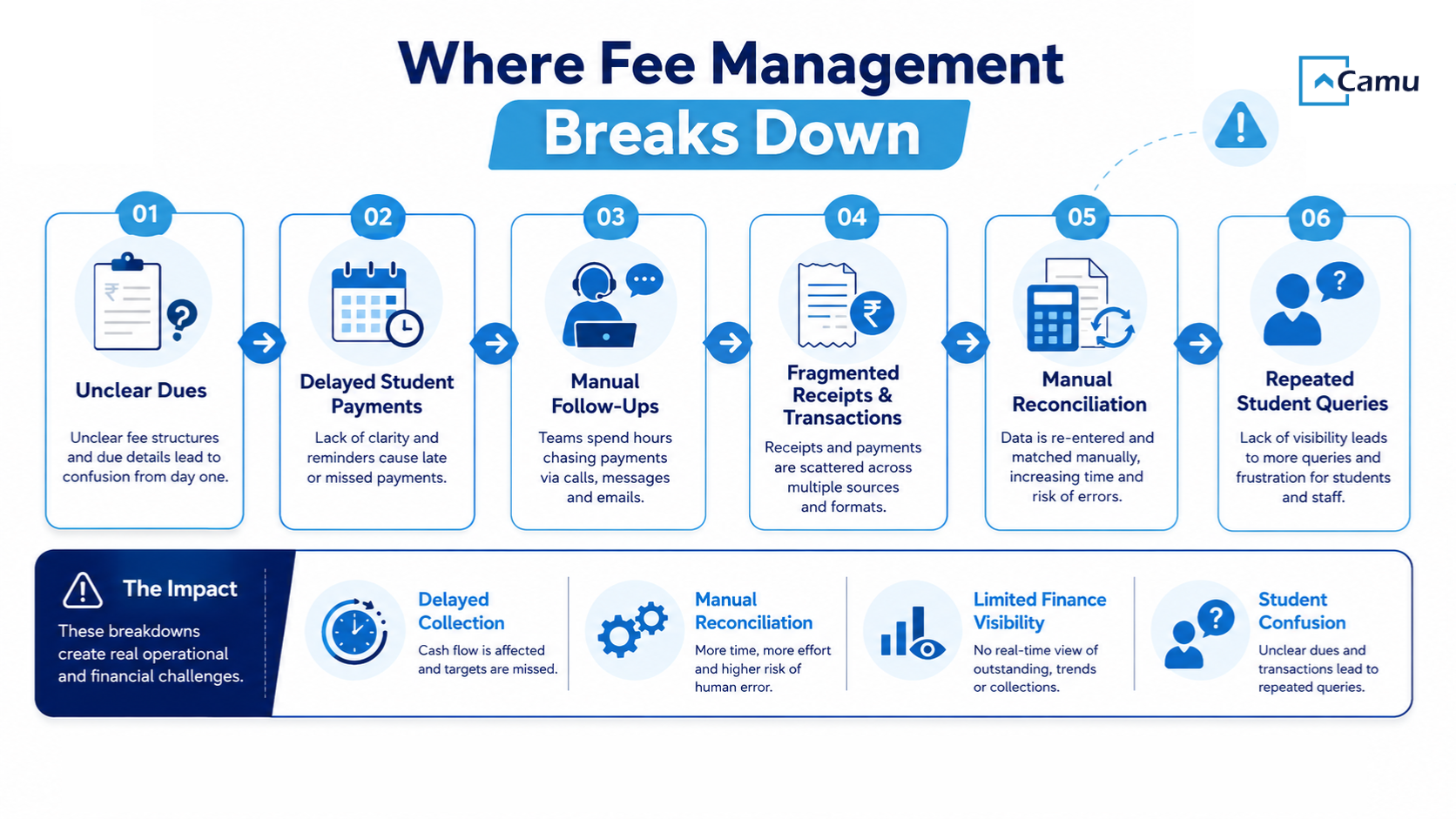
Many fee management problems happen because institutions treat fee collection as a payment activity rather than a complete financial workflow. Two common challenges stand out:
1. Delayed Fee Collection
Students who are unsure of what is due, when it is due, or how much is still owed frequently experience delayed collection. After that, finance teams rely on student-specific clarification, manual follow-ups, and regular reminders.
Managing several programs, batches, fees categories, billing schedules, concessions, penalties, and payment methods makes this more challenging.
2. Manual Adjustment
When invoices, receipts, online transactions, cheque payments, refunds, discounts, and outstanding balances are tracked across various records, manual reconciliation becomes difficult.
Verifying payments, comparing records, answering questions from students, and fixing errors can take a lot of work for finance personnel. These gaps can result in delayed updates, recurring student questions, and restricted visibility for finance departments at the institutional level.
The Scale Behind the Shift
According to AISHE 2021–22, India's higher education ecosystem consists of 1,168 universities and university-level institutions, 45,473 colleges, and 12,002 standalone institutes. Almost 4.33 crore students were enrolled overall during that time.
Simultaneously, digital payments have gained popularity. In FY 2024–2025, there were 22,167.90 crore commercial digital payments in India, with UPI accounting for 81 percent of these transactions.
Due to this change, institutions now require fee systems that are visible, traceable, and integrated throughout the whole fee lifetime in addition to being payment-enabled.
How Camu Helps Institutions Improve Fee Collection
Camu supports structured fee collection through billing features such as:
Payment Scheme
Billing Schedule
Bulk Invoice
Payment Reminder
Penalties
Online Transaction
Student Billing Category
Payer
These features allow institutions to generate invoices, manage reminders, configure fees, schedule billing, issue penalties, and track online transactions all within an integrated billing system. Finance staff can operate with clearly defined billing schedules, reminder routines, student-wise categories, and transaction visibility rather than relying solely on manual follow-up.
How Camu Gives Students Better Fee Visibility
Fee management becomes easier when students can clearly understand their payment position without depending on the finance office for every clarification.
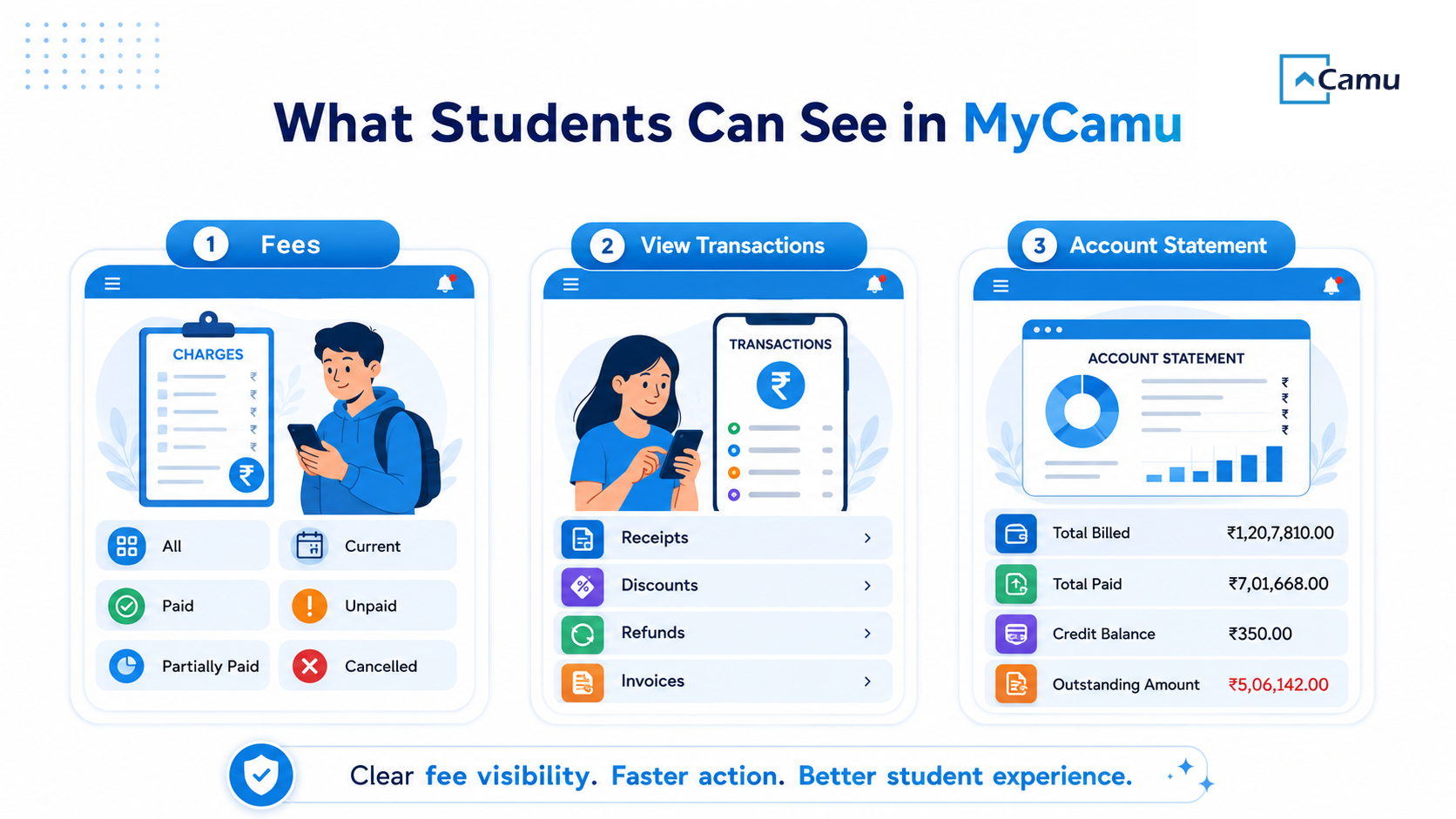
Through MyCamu, students can view their fee-related information in one place, including fees, payment status, transaction history, and account statement details. This gives them clarity on what has been billed, what has been paid, what remains outstanding, and what action is required.
Students can access charge details across statuses such as current, paid, unpaid, partially paid, and cancelled, along with key information such as bill item, due date, amount, outstanding balance, and payment status. They can also use the Pay Now option to act on pending dues directly.
Beyond charges, MyCamu also provides visibility into important transaction records such as receipts, discounts, refunds, and invoices. Students can view their account summary, including total billed, total paid, credit balance, and outstanding amount.
For institutions, this reduces repeated payment-related queries and improves transparency. For students, it creates a clearer, more self-service fee experience.
Why Student Visibility Is Central to Fee Management
A strong fee management system should not only help finance teams collect payments. It should also help students understand their financial position without repeated manual enquiries.
When students can view charges, receipts, refunds, discounts, invoices, and account statements on their own, institutions can reduce avoidable queries. This creates a shared financial view between the institution and the student.
Finance teams gain better control. Students gain better clarity. The institution gains a more transparent and efficient fee management process.
What Institutions Should Look for in a Fee Management System
Evaluation Area
Why It Matters
Billing configuration
Supports different fee structures, categories, and payment schemes
Billing schedules
Helps standardize fee timelines
Bulk invoice generation
Reduces repetitive billing effort
Payment reminders
Supports structured follow-up
Online transaction tracking
Improves payment visibility
Student self-service
Gives students access to charges, transactions, and account statements
Payer-level clarity
Supports student, guardian, sponsor, or other payer responsibility
Conclusion
Fee management cannot be treated as a basic payment function anymore. Camu helps institutions bring financial control for administrators and payment transparency for students. With Camu, institutions can manage fee structures, billing schedules, invoices, reminders, penalties, receipts, online transactions, and student account visibility within one connected digital campus platform.
Book a demo today and see how Camu can help your institution simplify fee management from billing to payment visibility.
Frequently Asked Questions
What is a fee management system in higher education?
A fee management system helps institutions configure fee structures, generate invoices, collect payments, issue receipts, manage reminders, track transactions, and provide students with visibility into their fee records.
Why do institutions struggle with fee collection?
Institutions often struggle because billing records, payment reminders, receipts, refunds, penalties, and outstanding balances are not managed through one connected workflow.
How does student self-service improve fee management?
Student self-service allows students to view charges, paid and unpaid status, receipts, refunds, invoices, and account statements directly. This reduces repeated finance-office queries and improves transparency.
How does Camu support fee management?
Camu supports staff-side billing workflows such as payment schemes, billing schedules, bulk invoices, receipts, reminders, penalties, online transactions, and payer details. It also enables student-side visibility into charges, transactions, and account statements.