Key Takeaways
Attendance management is not only about recording presence. It helps institutions maintain accurate academic records and support timely action.
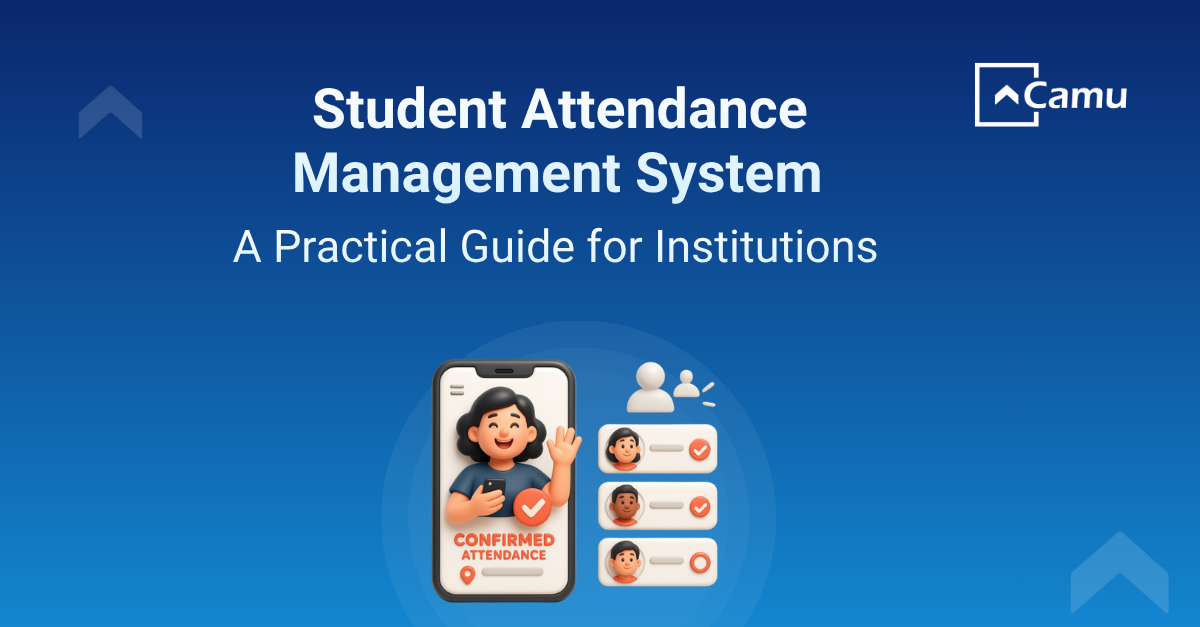
A student attendance management system helps schools and universities simplify attendance capture, tracking, communication, and reporting.
The right attendance process depends on the institution’s academic structure, attendance rules, and operational needs.
Modern attendance systems support multiple capture methods, better visibility, and stronger academic accountability.
Camu helps institutions manage attendance through configurable workflows, digital capture methods, communication, and connected academic processes.
Why Attendance Management Needs a Better Approach
Attendance, for teachers, is a daily responsibility. For administrators, it becomes an important academic record. For students and parents, it provides visibility into participation and attendance status. But as institutions grow, managing attendance becomes more complex.
Multiple classes, departments, sections, faculty members, and attendance policies make manual tracking difficult. Teachers spend time recording attendance. Administrators spend time consolidating reports. Students and parents often receive updates only after delays.
A student attendance management system helps institutions simplify this process by bringing attendance recording, tracking, communication, and reporting into one connected workflow.
How to Build an Effective Student Attendance Management Process
A good attendance process is not only about choosing a technology. It starts with defining how attendance should work within the institution.
1. Define the Right Attendance Structure
Every institution follows a different academic model.
Some schools may track attendance once a day. Others may require morning and afternoon attendance. Colleges and universities may need attendance tracking for every period, course, or lecture.
A School Attendance Management System should support the institution’s daily operations without forcing a fixed structure.
Similarly, an Attendance Management System for Students should give students visibility into the attendance model followed by their institution.
The right structure ensures attendance records match the actual academic environment.
2. Choose the Right Way to Capture Attendance
Attendance capture has moved beyond traditional registers.
Institutions today use different methods depending on their requirements and infrastructure.
These include: Manual attendance marking, QR code-based attendance, RFID-based attendance, Biometric attendance, Facial recognition attendance
The right method depends on factors such as classroom setup, student strength, speed requirements, and the level of automation needed.
A flexible attendance system allows institutions to choose the method that works best for their campus.
3. Maintain Accuracy Through Clear Attendance Rules
Recording attendance is only one part of attendance management.
Institutions also need clear rules around when attendance should be marked, how late attendance should be handled, and when attendance records become final.
Features such as attendance cut-off rules, late attendance tracking, and save-and-publish workflows help institutions maintain more reliable attendance records.
This creates a structured process where faculty can record attendance, review it, and finalize it with better control.
Student Attendance Management System Checklist
Before choosing an attendance system, institutions should consider:
Flexible Attendance Options
Does the system support the attendance model followed by the institution?
Faculty-Friendly Workflows
Can teachers manage attendance easily?
Student and Parent Visibility
Does the system improve transparency?
Reports and Insights
Can institutions understand attendance patterns?
Connected Academic Workflows
Does attendance work with other institutional processes?
How Camu Supports Student Attendance Management
Camu helps institutions manage attendance as part of the larger academic workflow.
Institutions can configure attendance based on their operational requirements, including period attendance, morning attendance, afternoon attendance, and day attendance. Camu supports multiple attendance capture methods, including manual attendance, QR code, RFID, biometric, and facial recognition. This gives institutions the flexibility to choose the approach that fits their campus environment.
The platform also supports attendance cut-off rules, late attendance tracking, and save-and-publish workflows. Faculty can record attendance, review it, and publish finalized records for student visibility. Attendance communication can also be managed through SMS and email, helping institutions keep students and parents informed about attendance updates.
Because attendance works alongside academic workflows, institutions get better visibility across student records, timetable, teaching activities, and reports.
With Camu, institutions can manage:
Configurable attendance models
Multiple attendance capture methods
Attendance cut-off rules
Late attendance tracking
Student attendance visibility
Parent and student communication
Reports and dashboards
Connected academic workflows
Conclusion
Attendance management is more than marking students as present or absent.
For institutions, it is a process that supports academic accountability, student visibility, and timely intervention.
A well-designed student attendance management system helps institutions create accurate records, simplify daily workflows, and make attendance information more useful.
With the right combination of process, technology, and visibility, attendance becomes easier to manage for teachers, administrators, students, and parents.
Every student. Every class. Always accounted for.