Features of Students information system for Educational Institutions?
Loading content...
Stay up to Date
Recent Posts
Loading content...
Stay up to Date
Recent Posts
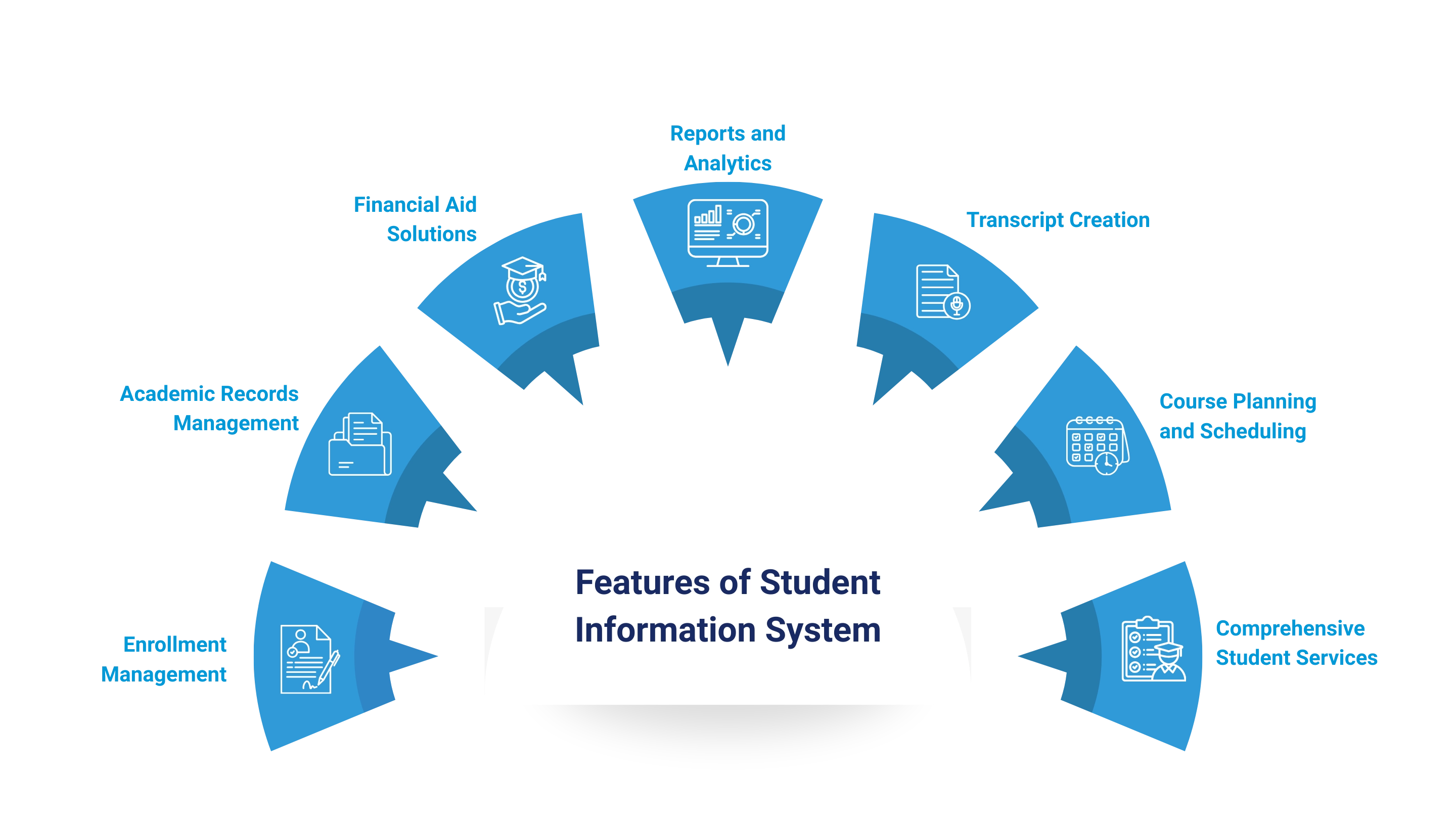
Features of the Student Information System
Enrollment Management
Academic Records Management
Financial Aid Solutions
Reports and Analytics
Transcript Creation
Course Planning and Scheduling
Comprehensive Student Services
Challenges faced by Educational institutions Vs Solutions offered by Camu’s SIS
Conclusion
Managing student data and workflow efficiently is a daunting task for every educational institution, whether it be a school, college, or university. This is where academic institutions need a Student Information System (SIS) to simplify the processes and provide a host of other benefits.
Streamline admissions, academics, and administration with a smart, scalable Student Information System.
This student management system software helps in enhancing the functioning of the educational environment by streamlining the process. It won't be wrong to say that student management systems are reshaping the educational experience globally.
Enrollment is the core academic process to kick-start a student's educational journey. The student enrollment system is a centralized hub for efficient and seamless management of admissions.
The institutes can offer a standardized admission process to the students for a hassle-free experience.
The system automates the various processes, such as application submission, verification of certificates, fee payments, etc., and manages all the relevant information to boost the efficiency of the admission process.
It helps the students and the parents to thoroughly understand the admission process and formalities without any confusion, minimizing the necessary waiting time for the students and the college management.
This is one of the key advantages of the student information system. The educational institutes can quickly and efficiently save, manage, and retrieve the academic and personal records of the students.
It serves as a central unit to preserve the essential personal and academic data of every student without any duplication of data.
This also lowers the possibility of any error, mistake, or loss of the relevant data.
Student Information Systems implemented by universities and colleges also assist students in obtaining approvals for financial aid, such as scholarships and educational loans.
faculty members can focus their efforts entirely on student success rather than expending time on administrative tasks.
As the system is the centralized hub for student's data and records, it can be trusted to get a comprehensive report of a student's performance and achievement.
This helps to easily identify and improve the learning gaps in the educational journey of a student.
It provides real-time data of students and thus helps teachers and educational experts to provide personalized guidance and support.
The system also provides analytical information that helps the management in making evidence-based decisions.
maintains an official record of the overall academic journey of every individual student. These records are accurate and free from errors and thus, can be trusted for their relevance.
provide supplementary information about the students such as their career plans and life goals.
These transcript reports are used by the teachers to personalize the pedagogical approach for each student and enhance their learning experience.
the reports can be accessed from anywhere to guide the students as and where necessary. It keeps the students aware of their growth potential.
The educational institutes and teachers can make use of the SIS for planning and scheduling the course.
efficiently handles the management of the academic course schedules without any conflicts. It also helps to plan the course details relevant to the accurate information.
ensures that the administrators can easily assign classrooms and time slots without any confusion. It simplifies the teaching planning and scheduling experience for learners and educators alike as well as for the teaching staff.
The system also assists the educational institutes in personalizing the course design and outlines according to each student's unique needs.
The online Student Management System, in addition to automating and streamlining processes for storing, maintaining, retrieving, and compiling student data, also helps the institution conveniently track students' regular activities.
It can be utilized to provide broad-ranging services that support students in exploring and developing their careers.
Boost student engagement to explore, identify, and commit to the potential opportunities to satisfy their passions and interests.
Institutes can provide better career counseling, job placement assistance, guidance, and support to help students connect with subject matter experts and discover suitable industrial opportunities.
| Institutional Challenges | How Camu’s SIS Solves It |
| Missing coordination between academic and administrative departments. | Establishes a single, unified platform that bridges departments. |
| Disparate systems for admissions, academics, exams, and finance. | Consolidates all workflows into one integrated SIS, eliminating data silos. |
| Manual, error-prone student record management. | Digitizes the entire student lifecycle with centralized, and accurate records. |
| Complex academic regulations and flexible program structures. | Supports CBCS, NEP 2020, electives, credits, and multi-disciplinary programs. |
| Limited visibility into student progress and learning outcomes. | Provides real-time dashboards, analytics, and OBE-aligned tracking. |
| Accreditation readiness and compliance challenges (NAAC, NBA, PAASCU, etc.) | Generates structured reports, evidence mapping, and compliance-ready documentation. |
An integrated student information system eases the work of educational institutes to ensure smoother operations. It boosts the efficiency of the institute to stay ahead of the competitors with improved outcomes, resulting in better performance.
Unlock the power of Camu's cutting-edge student management system software, designed especially to make your approach to student management and administrative needs. Centralize student data management, streamline the administrative processes, enhance communication, and automate the routine processes to boost efficiency with the Camu SIS system.
What are the core features of a Student Information System?
A Student Information System includes enrollment management, academic records, financial aid, reports and analytics, transcript generation, course scheduling, and comprehensive student services.
How does SIS improve enrollment and admissions management?
SIS automates up to 70% of the admission workflow, including applications, document verification, and fee processing, reducing delays and manual errors.
How does SIS help manage academic records efficiently?
SIS centralizes student records in a single database, reducing data duplication by over 60% and ensuring quick retrieval of accurate academic information.
Can SIS support financial aid and scholarship management?
Yes. SIS helps track scholarships, educational loans, and approvals while minimizing administrative workload for faculty and finance teams.
What role does SIS play in transcript creation?
SIS generates error-free academic transcripts that reflect a student’s complete academic journey and can be accessed anytime for academic or career guidance.
What challenges do institutions face without an integrated SIS?
Without SIS, institutions struggle with data silos, manual errors, limited student visibility, and compliance challenges across departments.