Attendance information can connect with student records, timetables, teaching activities, LMS, examinations, and analytics.
Connecting attendance with academic systems reduces fragmented records and gives faculty and administrators better context.
Attendance data can support reporting, student communication, academic follow-up, and institutional visibility.
Why Attendance Should Not Work in Isolation
A faculty member records who attended a session, and the system stores the record for future reference. But attendance does not exist separately from the academic journey.
The class itself comes from the academic timetable.
The students attending it are connected to a course and programme.
The faculty member is assigned to the session.
The resulting attendance record becomes part of the student's academic information. It can also contribute to reports, communication, academic reviews, and examination-related processes. When these activities are managed separately, teams have to move information between different systems or consolidate it manually.
The shift is simple: Attendance is no longer only about recording presence. It becomes part of a connected academic information flow.
Where Attendance Connects With Academic Workflows
Academic Workflow
How Attendance Connects
Attendance and Student Records
Attendance forms part of the student’s broader academic record, alongside programme, course, enrolment, and academic progress information.
Connecting these records gives academic teams better context when reviewing attendance and helps maintain consistent records across departments, programmes, and courses.
Attendance and Academic Timetables
Attendance starts with a scheduled academic session. Connecting attendance with the timetable aligns attendance records with the scheduled class, course, faculty member, and period.
It also supports period-wise attendance workflows and reduces the need to create attendance records separately.
Attendance and Teaching Activities
Connecting attendance with teaching workflows links planned academic delivery with student participation.
Faculty can manage attendance alongside their academic activities, helping keep attendance information aligned with the teaching process.
Attendance and LMS Workflows
Students engage with learning through course content, assignments, assessments, and other LMS activities.
Connecting attendance with LMS workflows gives academic teams a broader view of student activity across attendance and learning.
Attendance and Examination Management
Attendance information often needs to be reviewed alongside examination rules and eligibility requirements.
Connecting attendance with examination workflows reduces the need to move attendance records manually between systems.
Attendance and Analytics
Connected attendance data can be reviewed through summaries, reports, dashboards, and analytics.
Camu’s Heads Up feature provides a quick summary of attendance information and highlights attendance performance and patterns, giving educators and administrators broader visibility.
From Attendance Records to Institutional Visibility
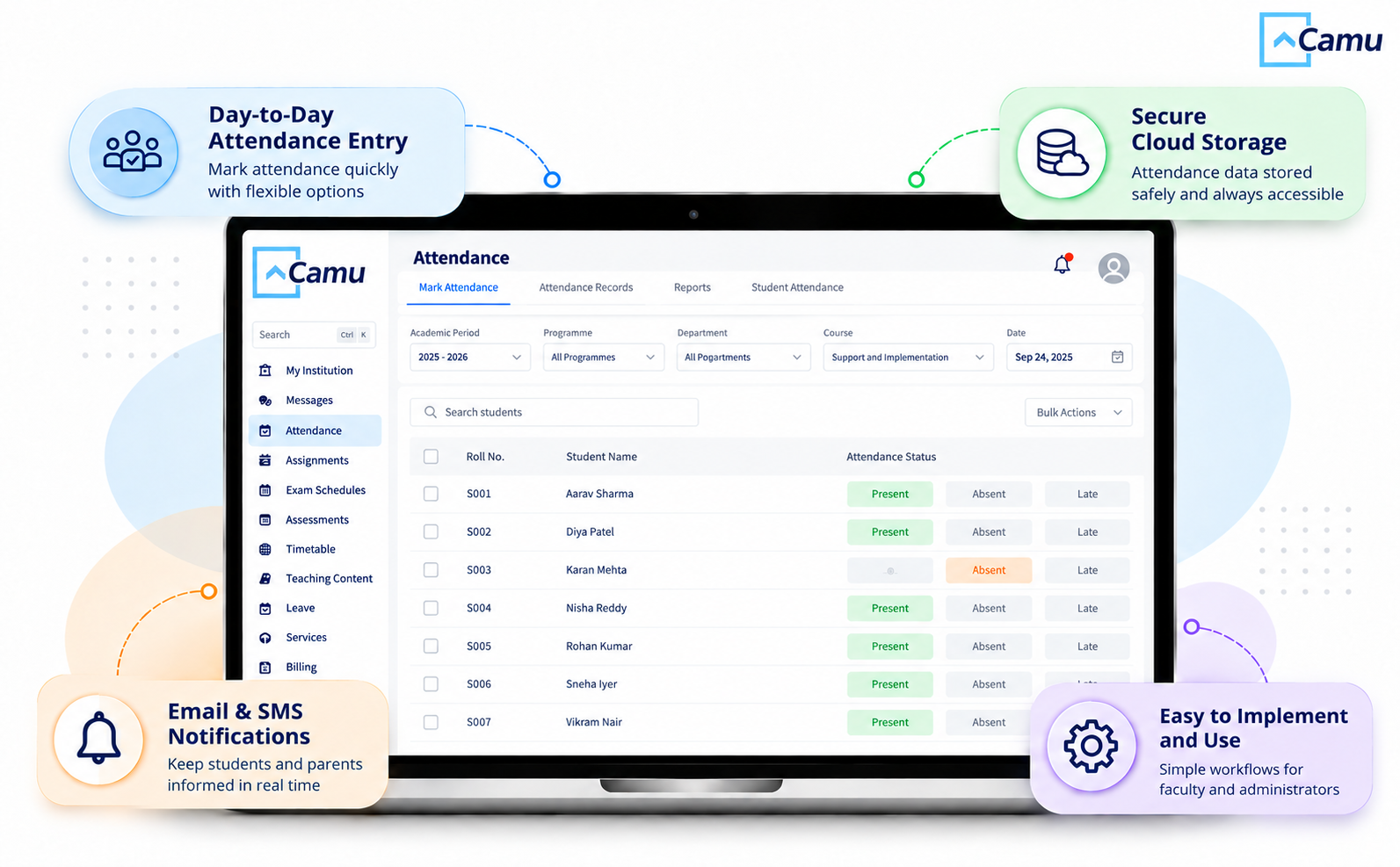
Attendance Management System Dashboard
A connected attendance workflow creates information that different teams can use for different purposes.
Faculty may need to review attendance for their classes.
Academic heads may need course or department-level visibility.
Administrators may need reports for institutional monitoring.
Students may need access to their own attendance records.
Parents may need relevant attendance notifications where the institution's communication model includes them.
Leadership teams may need consolidated attendance information across programmes or campuses.
A modern Online Attendance Management System therefore needs to do more than provide digital attendance marking. It should help move attendance information through the wider institutional workflow.
Camu supports this through real-time attendance visibility, dashboards, reports, automated alerts, and integration with SIS, LMS, Exam Management, and Analytics.
What a Connected Attendance Management System Should Enable
A connected approach to attendance should help institutions maintain a clear flow of information from the classroom to institutional reporting.
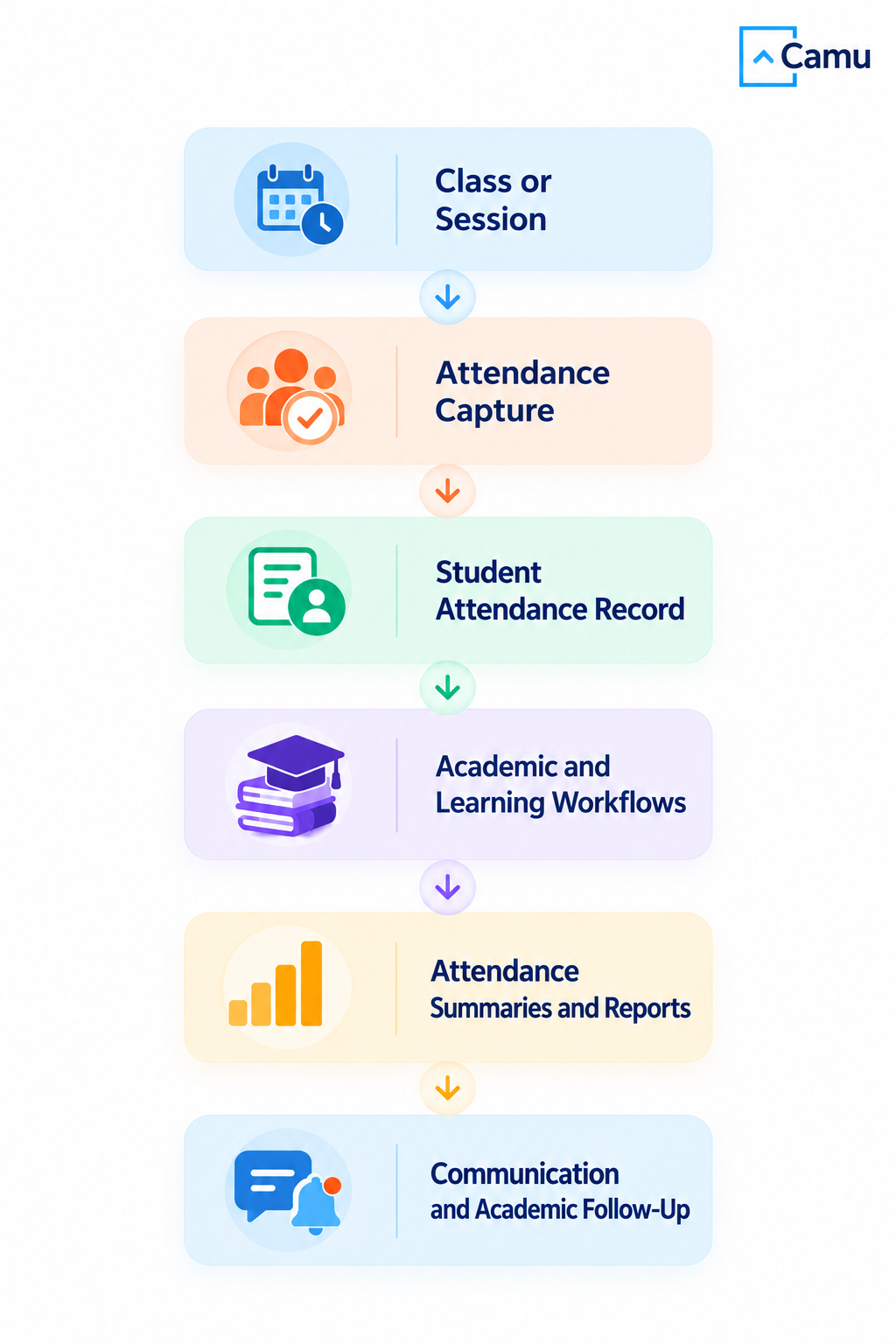
The workflow can look like:
Attendance Management System Workflow
The value comes from keeping these stages connected.
For example, attendance captured during a scheduled session becomes part of the student's record. The information is then available for reporting, communication, analytics, and relevant academic processes.
This reduces the need to treat attendance as a separate database or administrative activity.
How Camu Connects Attendance Across the Digital Campus
Its attendance system supports multiple attendance models, including session, course, and day-based attendance. It also supports QR code, biometric, facial recognition, and mobile-based attendance workflows.
More importantly for connected academic operations, attendance data integrates with SIS, LMS, Exam Management, and Analytics. This allows attendance information to move across academic and administrative workflows where it matters.
Camu also provides attendance summaries through Heads Up, real-time dashboards, reports, alerts, and student visibility. These capabilities help institutions move from individual attendance records toward broader attendance visibility
The result is a connected attendance process where attendance capture, student information, academic activity, reporting, and institutional insights work together.
Connected Attendance, Better Outcomes Across the Student Journey
Attendance is one part of the larger academic workflow. When it operates separately, institutions have to manage records across different systems and processes. When it is connected with student records, timetables, learning workflows, examinations, and analytics, attendance information becomes easier to access and more useful across the institution.
A student attendance management system should therefore do more than record who was present or absent. It should connect attendance with the academic processes around it.
Explore how Camu's Attendance Management System helps institutions connect attendance with the wider digital campus through integrated academic workflows, real-time visibility, analytics, and reporting.
FAQs
1. Why should attendance be connected with academic workflows?
Connecting attendance with academic workflows helps institutions keep attendance information aligned with student records, courses, scheduled sessions, learning activities, examinations, reporting, and analytics.
2. How does attendance connect with a Student Information System?
Attendance can form part of the student's broader academic record, giving authorized academic and administrative teams access to attendance information alongside relevant student and course data.
3. Can attendance management systems integrate with an LMS?
Yes. Attendance systems can connect with LMS workflows so institutions have a broader view of attendance and learning-related information. Camu integrates attendance with its LMS.
4. How does attendance data support academic reporting?
Connected attendance data can be used for student-level, class-level, course-level, and institutional reporting. Dashboards and summaries help teams review attendance information without relying on separate manual records.
5. How does Camu connect attendance with other academic systems?
Camu integrates attendance with SIS, LMS, Exam Management, and Analytics. This supports information flow across academic and administrative workflows.