Most institutions only offer an illusion of CBCS, with limited flexibility despite more electives. True CBCS, as seen globally, enables full student choice through a term-based (Odd/Even) system. However, its complexity makes manual implementation unfeasible, requiring a robust IT backbone. Ultimately, institutions must choose between legacy structures or a future-ready, fully flexible model that unlocks true capacity and choice. The core problem is that CBCS is not just about offering more electives. It is a fundamental shift in how education is delivered, moving from an institution-centric model to a student-centric one.
Table Of Contents
What Most Institutions Call CBCS Today
What True CBCS Actually Looks Like (The Global Model)
Reduced duplication and improved institutional efficiency
From Theory to Practice: Saveetha Engineering College
Conclusion: An Operational Transformation
What Most Institutions Call CBCS Today
The majority of Indian institutions still operate on a fixed enrolment model. Under this traditional structure, students move through their degrees as a rigid cohort or "batch."
Even when "choices" are offered, they are typically limited to a small pool of electives within a fixed schedule. Students generally take the same courses at the same pace as their peers, with little to no say in who teaches them or when the classes occur.
We call this "controlled flexibility." The institution offers more courses across programs, but the student remains tethered to a specific section. Essentially, the experience remains unchanged; it is simply a batch-based model with more options on the menu.
What True CBCS Actually Looks Like (The Global Model)
True CBCS, as practiced globally and envisioned by NEP 2020, operates on a term-based structure (Odd/Even, Fall/Winter/Summer) rather than a linear year-on-year progression.
In this model, the "batch identity" disappears. Departments or Schools offer courses based on demand, and registration is open to students across various programs and levels.
In a true CBCS environment, students choose:
Their Courses: Selecting from a wide multidisciplinary pool.
Their faculty: Choosing faculty based on personal preference.
Their Time Slots: Designing a schedule that suits their own pace and convenience.
This creates dynamic capacity planning. Instead of empty classrooms or overstuffed sections, slots are introduced based on real-time registration data, ensuring optimal resource use.
Why This Model is Hard to Implement
Academic planning becomes exponentially complex when you remove the fixed batch structure. Institutions must forecast course demand, allocate faculty across multiple departments, and coordinate complex timetables without conflicts.
You are no longer managing one schedule for 60 students; you are managing individual schedules for thousands.
Manual processes or fragmented legacy systems cannot handle the weight of:
Enforcing complex prerequisites for every individual.
Managing credit limits (minimum and maximum) per term.
Preventing slot clashes during the registration window.
Without a robust digital infrastructure, the dream of flexibility quickly turns into administrative chaos.
Technology: The Backbone of True Choice
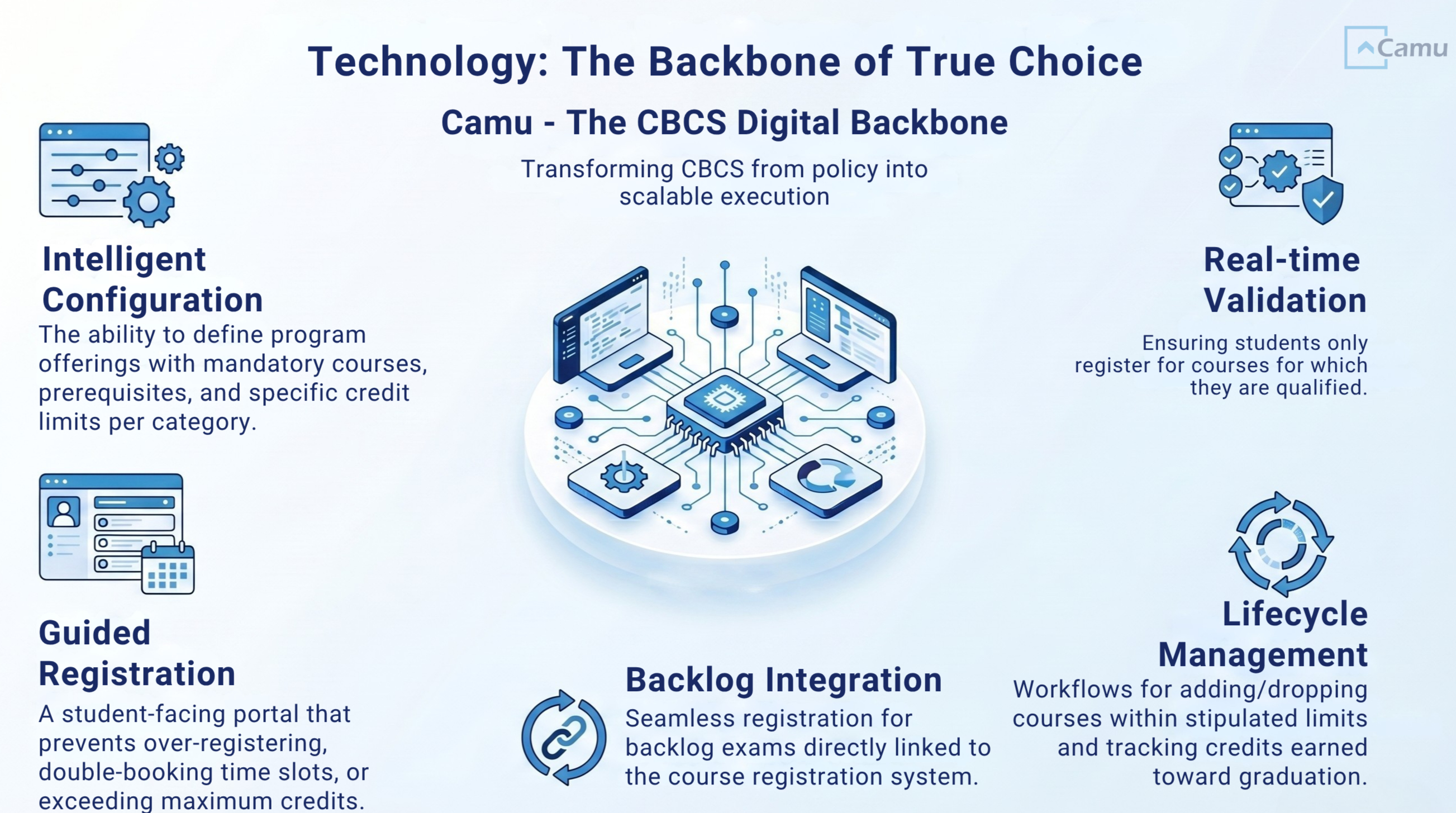
To enable a flexible enrolment model, technology cannot be just a support layer it must serve as the core functional backbone of the institution. Camu serves as this enabler, providing the digital governance required to transition from a fixed to a global model.
A true CBCS-ready system must offer:
Intelligent Configuration: The ability to define program offerings with mandatory courses, prerequisites, and specific credit limits per category.
Guided Registration: A student-facing portal that prevents over-registering, double-booking time slots, or exceeding maximum credits.
Real-time Validation: Ensuring students only register for courses for which they are qualified.
Lifecycle Management: Workflows for adding/dropping courses within stipulated limits and tracking credits earned toward graduation.
Backlog Integration: Seamless registration for backlog exams directly linked to the course registration system.
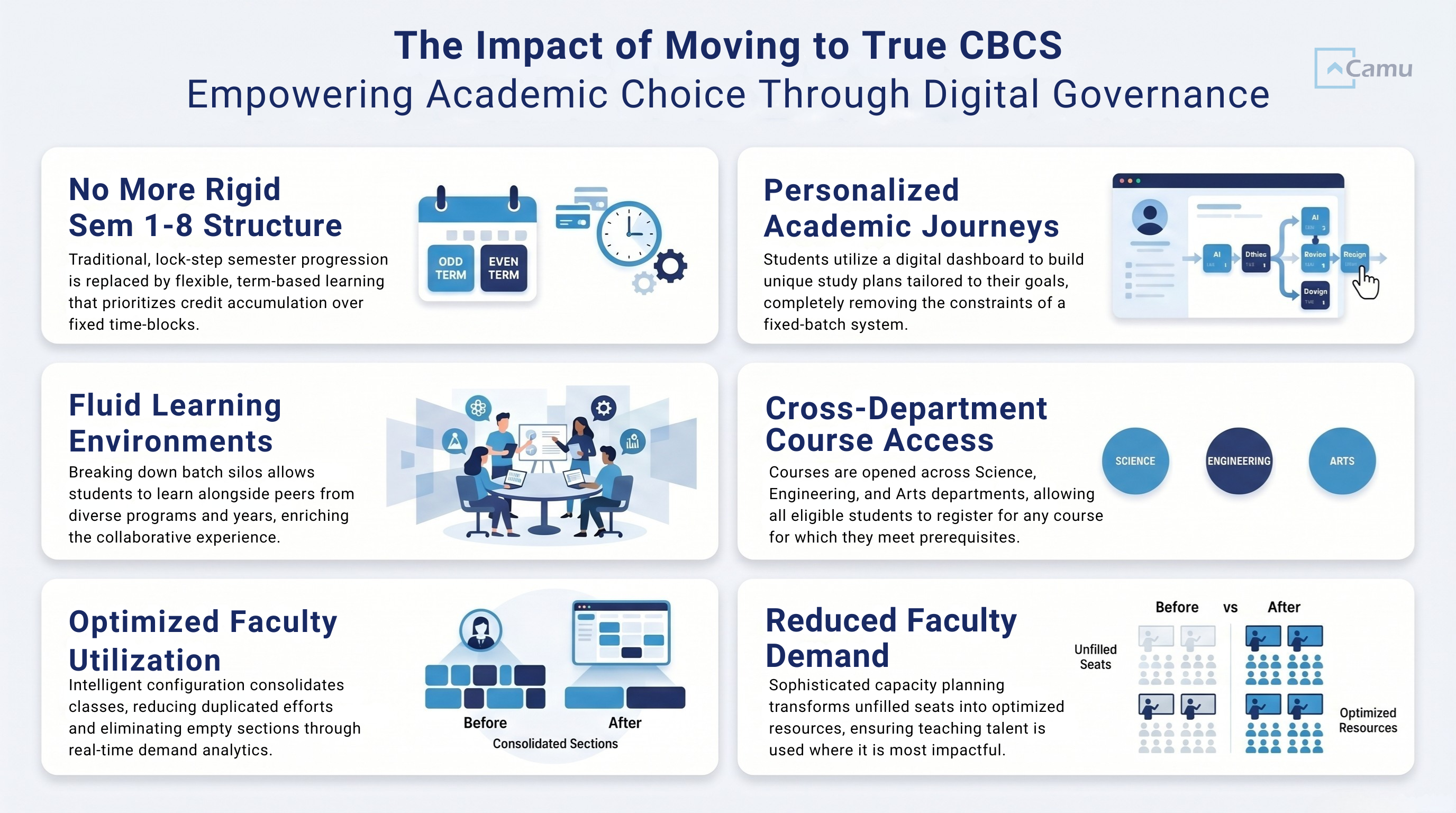
The Impact of Moving to True CBCS
No More Sem 1–8 Structure: The rigid semester progression disappears, replaced by flexible Odd/Even terms.
Personalized Academic Journeys: Every student builds a unique study plan, with no fixed cohort or batch system.
Fluid Learning Environment: Students move across classrooms, learning with peers from different programs and years.
Cross-Department Course Access: Courses are no longer restricted by department-all eligible students can enroll.
Reduced Faculty Demand: Better capacity planning leads to more efficient use of teaching resources.
From Theory to Practice: Saveetha Engineering College
When Saveetha Engineering College transitioned to autonomy in 2019, it wasn’t just a regulatory milestone; it was an operational turning point. Managing 4,300 students across 25 programmer meant moving beyond batch-based systems to something far more dynamic: thousands of individualized academic journeys. To make this shift real, it needed a digital backbone capable of handling the complexity of true choice. This is where Camu stepped in.
Camu enabled Saveetha to transition from a fixed batch model to a fully individualized academic structure from the very first semester. Its intelligent registration engine automated prerequisite enforcement prevented scheduling conflicts, and managed credit limits for every student independently. Timetables shifted from weeks of manual coordination to a single upload, with attendance, assessments, and academic tracking moving entirely to digital workflows.
Demand-based capacity planning freed 60 classrooms and achieved a 95% occupancy rate across the institution. The outcome is best captured by Dr. S. Rajesh, Director of Saveetha Engineering College:
"Many universities label their curriculum as a Choice-Based Credit System, but in reality, they offer only limited flexibility. Our goal was 100% student flexibility, and Camu made it possible. Today, we have 7,000 unique schedules for 7,000 students."
This is precisely the operational transformation that true CBCS demands, and what the right technology backbone makes possible.
Conclusion: An Operational Transformation
The implementation of true CBCS is not merely a policy shift; it is a total operational transformation. It requires a complete rethink of academic structures, reporting nomenclature, and a robust IT infrastructure.
For Indian institutions, the choice is clear. You can stay within the "controlled flexibility" of the Sem 1–8 model, or you can embrace the global standard of student empowerment. Future-ready campuses are those that stop viewing students as batches and start viewing them as individuals.
By adopting the right technology, institutions can finally deliver the "choice" that NEP 2020 promises.